
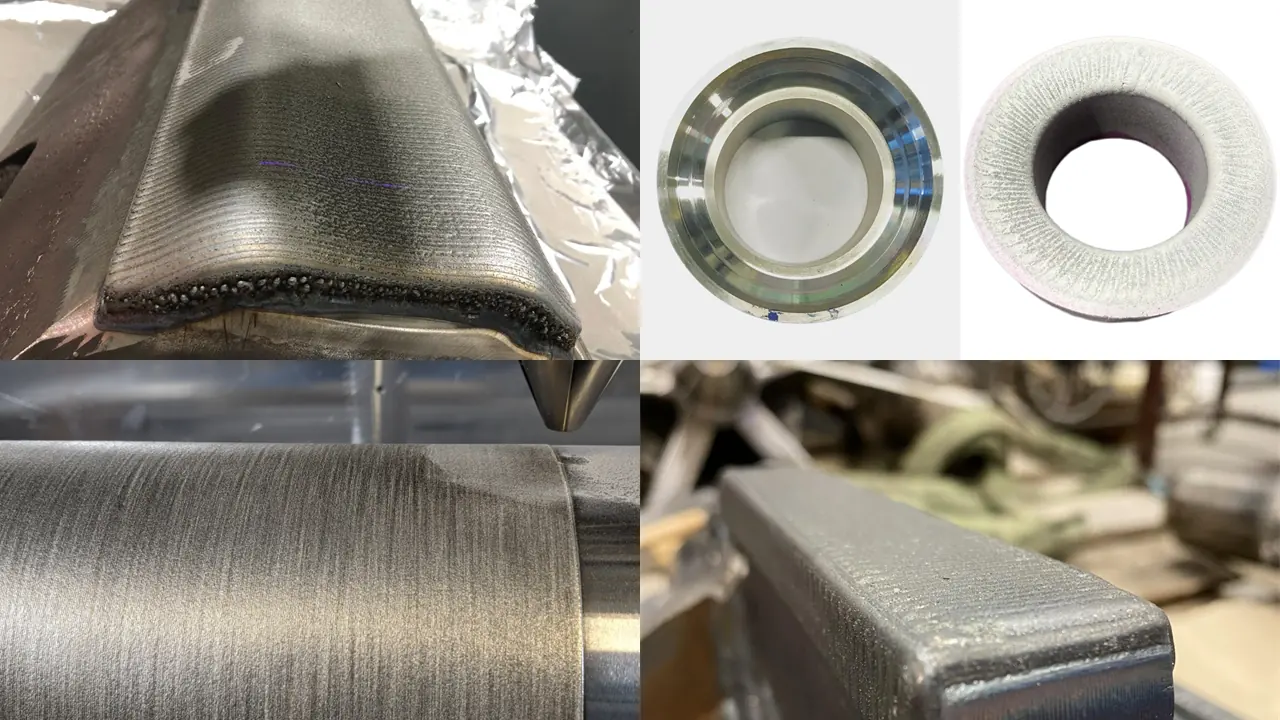
In 2024, Exafuse publicly reported more than 1,850 kg of material deposited through Laser Metal Deposition work. More than 1,600 kg was 316L stainless steel, with around 250 kg across advanced material families including Inconel-type nickel alloys, Triballoy wear alloys, copper alloys and specialty steels. For industrial buyers, the useful signal is not a generic material catalogue. It is evidence that LMD material selection at Exafuse is tied to real deposition work, process adjustment and part-specific review.
The exact powder or alloy for a customer part still depends on substrate, function, service environment, heat input, finishing and inspection scope.
Who this article helps
This article is useful for buyers who already know that material choice is central to the job, but are not sure how to frame the discussion.
It is most relevant for:
- Maintenance and plant teams comparing repair, rebuild and replacement routes.
- Buyers looking for wear, corrosion or high-temperature surface protection.
- OEM and product-development teams evaluating LMD for hard-to-machine or expensive alloys.
- Technical evaluators who need to understand material breadth before asking for a feasibility review.
What the 2024 material mix shows
The 2024 material mix is a proof point for process breadth. It shows repeated deposition work with a high-volume stainless route and a smaller but important range of advanced alloys.
The public numbers from the post are:
- More than 1,850 kg of deposited material in 2024.
- More than 1,600 kg of 316L stainless steel.
- Around 250 kg of advanced materials across corrosion-resistant, high-temperature, wear-resistant, copper and specialty steel routes.
This should be read as material experience, not as a promise that every listed alloy is always available, qualified or suitable for every substrate.
316L stainless steel as the volume backbone
316L stainless steel made up the largest share of the 2024 material volume. For LMD buyers, that matters because stainless routes are common in industrial repair, build-up and corrosion-relevant work.
316L can be relevant when the project needs stainless corrosion resistance, weldability, geometry restoration or stainless-compatible build-up. The real question is still part-specific: base material, dilution, heat sensitivity, final machining and inspection decide whether 316L is the right route.
High-temperature and corrosion-resistant materials
The 2024 post named Inconel 625, C276 and C282 among high-temperature and corrosion-resistant materials. It also mentioned Ni-based alloys and C939 in the wider advanced-material mix.
These names are useful for buyer language because many industrial inquiries start with nickel-alloy or Inconel-type requirements. The engineering decision should still start from:
- Operating temperature.
- Corrosive medium or oxidation exposure.
- Thermal cycling.
- Base material compatibility.
- Final surface and inspection requirements.
For these cases, the first step is usually a corrosion and temperature review, not an instant grade prescription.
Wear-resistant and tribology-focused materials
The post named Triballoy 400, Triballoy 800, S6, S12 and FeCrV15Ni6 as wear-resistant coating or surface-performance examples. WSC was also included in the advanced-material list.
For cladding buyers, these names belong in a failure-mode discussion. Abrasion, erosion, sliding contact, galling, hot wear and impact do not all need the same material logic. A hard material can be wrong if the part also sees impact, cracking risk, thermal cycling or difficult post-machining.
Laser cladding projects should therefore start with the damaged surface and the duty cycle, then narrow the alloy family.
Copper and conductive alloy work
The 2024 mix also included Cu 99.95% and CuNi3Si. Copper alloy work is a useful capability signal because high conductivity, heat flow and laser coupling can make copper-family deposition different from standard steel deposition.
For copper-related inquiries, buyers should describe whether the value is thermal conductivity, electrical conductivity, cooling performance, repair of an existing copper part, or a copper-compatible material transition.
Specialty steels and hard-to-machine routes
The post also listed 4116, H500 and PH-14 among specialty steels. These names are useful when the buyer is thinking about tool steels, stainless grades, precipitation-hardening or high-performance steel routes.
In LMD, the manufacturing logic is often strongest when the alloy is expensive, difficult to machine from solid stock, or only needed in selected zones. Depositing material locally can reduce waste and concentrate the high-value material where it creates function, but machining and validation still need to be planned.
What this proof point does not prove
Material variety does not remove the need for technical review.
It does not automatically prove:
- Final part qualification for every listed alloy.
- Certified mechanical properties for every geometry.
- Suitability for every substrate.
- A guaranteed surface finish without post-processing.
- A fixed lead time or price for every material route.
The stronger interpretation is that Exafuse has public evidence of broad LMD material work and can discuss material-family routes with more context than a generic powder list.
How buyers should use this material evidence
Use the material list as a starting vocabulary for the feasibility conversation.
For repair and modification, send:
- Base material if known.
- Photos of the worn, damaged or undersized area.
- Original drawing or nominal geometry if available.
- Function of the repaired zone.
- Required machining, heat treatment or inspection.
For cladding and surface protection, send:
- Failure mode: abrasion, corrosion, oxidation, sliding contact, hot wear or impact.
- Surface area and target layer thickness if known.
- Operating temperature and medium.
- Required surface finish after cladding.
- Documentation or validation expectations.
For new LMD or hybrid manufacturing, send:
- CAD and drawing.
- Target alloy family or named material if already specified.
- Overall dimensions, approximate mass and quantity.
- Functional surfaces and tolerances.
- Post-machining and inspection requirements.
Recommended next steps
Start with the page or tool that matches the material question:
- Materials overview for Fe-, Ni-, Co-, copper and specialty steel framing.
- Material selector for a first material-family direction.
- Alloy selection for laser cladding for surface protection and wear/corrosion tradeoffs.
- Corrosion and high-temperature protection for Inconel-type and Ni-based discussions.
- LMD for hard-to-machine alloys for expensive alloy build-up and hybrid manufacturing.
- RFQ builder to prepare a clearer inquiry.
Send a material review request
Send base material, target property, failure mode, dimensions, photos or CAD, operating environment and inspection expectations.
Request an alloy or material review
FAQ
Does Exafuse work only with 316L stainless steel?
No. 316L was the largest public 2024 volume, but the same post also named nickel alloys, wear-resistant alloys, copper alloys and specialty steels. Final material suitability is reviewed by part.
Does the 2024 material list mean every alloy is qualified?
No. The list is a proof point for deposited material experience. Qualification, documentation and release criteria still depend on the part, substrate, service environment and agreed inspection plan.
Which named materials were included in the 2024 post?
The post named 316L stainless steel, Inconel 625, C276, C282, Triballoy 400, Triballoy 800, S6, S12, FeCrV15Ni6, WSC, Ni-based alloys, C939, Cu 99.95%, CuNi3Si, 4116, H500 and PH-14.
What should I send if I have a material-specific request?
Send the base material, target alloy or property, service environment, photos or CAD, affected surface or build volume, required finish and any inspection or documentation requirement.