
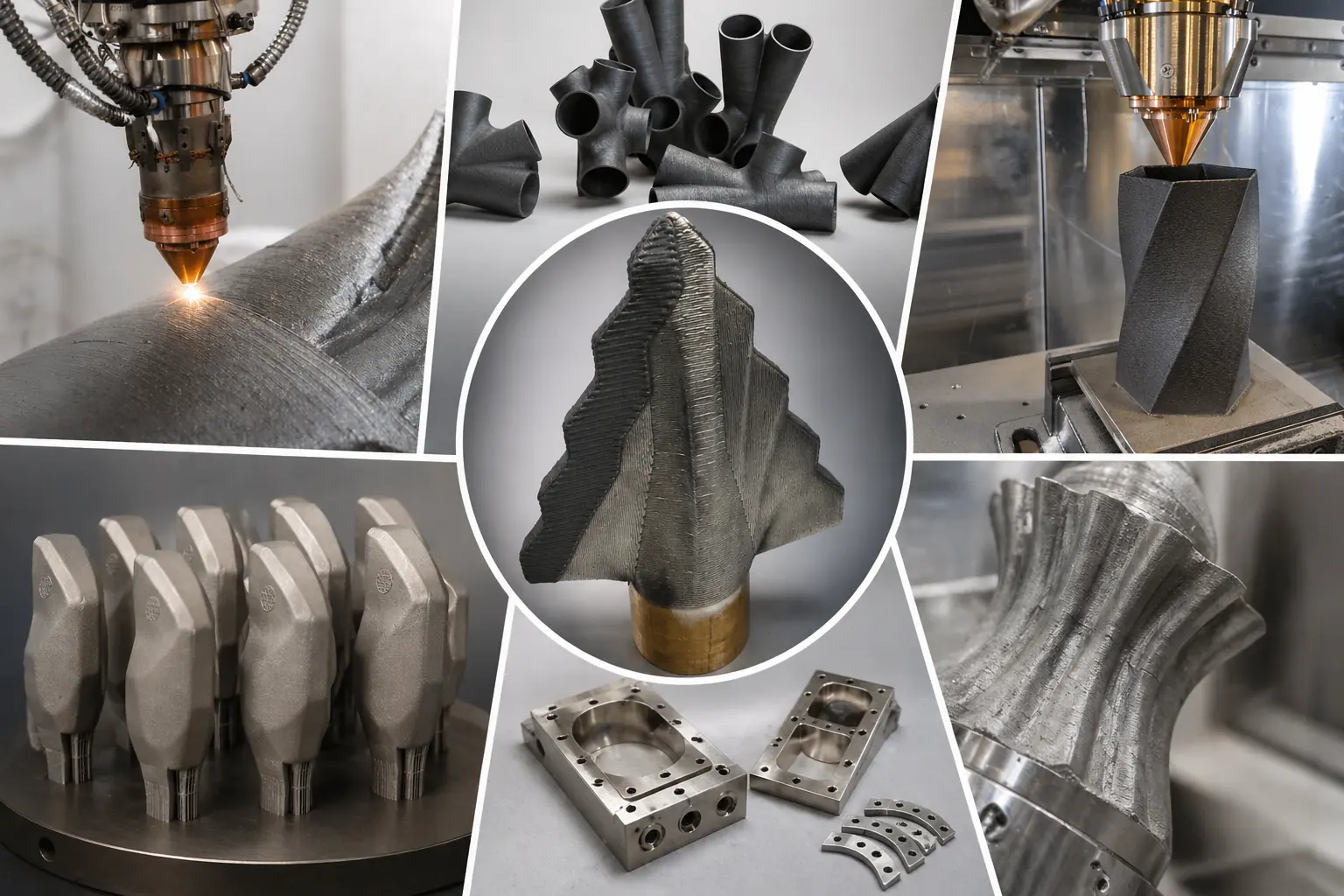
Exafuse has publicly shown a complex 750 mm water-cooled nozzle design manufactured by Laser Metal Deposition with two Ni-based alloys: Inconel 625 for the inner structure and Inconel 718 for the outer structure and cooling ribs. The proof build was described as a thin-walled 1.8 mm structure, produced in around 50 hours over two uninterrupted printing days with more than 1,070 layers.
The useful buyer takeaway is not that every thin-wall or multi-material geometry is automatically feasible. It is that LMD can address demanding geometry, high-temperature material logic and multi-material path planning when the design is engineered for the process from the beginning.
Who this article helps
This article is for industrial teams evaluating whether LMD can move beyond simple build-up and into more demanding component geometries.
It is most useful for:
- Product-development and OEM teams exploring additive routes for functional metal designs.
- Engineering teams comparing LMD, SLM / LPBF and hybrid routes for cooling or thermal applications.
- Buyers working with Ni-based alloys, Inconel-class materials or expensive hard-to-machine alloys.
- R&D teams reviewing multi-material deposition, thin-wall geometry and validation needs.
- Procurement teams preparing RFQs where material, geometry and inspection all affect feasibility.
What the 750 mm nozzle proof shows
The water-cooled nozzle proof shows that LMD can be used for more than local repair or simple cladding.
It demonstrates four important capabilities:
- Large thin-wall geometry: a 750 mm structure with 1.8 mm wall context requires stable path planning, thermal control and consistent layer build-up.
- Multi-material construction: Inconel 625 and Inconel 718 were assigned to different functional regions instead of treating the part as one uniform alloy.
- Cooling-feature logic: the outer structure and cooling ribs show why geometry, heat flow and material selection have to be planned together.
- Long uninterrupted build discipline: around 50 hours and more than 1,070 layers make process stability and monitoring relevant, not optional.
This should be treated as a public proof story and feasibility signal, not as a universal guarantee for every thin-walled component.
Why Inconel 625 and Inconel 718 were paired
The public proof story described Inconel 625 for the inner structure and Inconel 718 for the outer structure and cooling ribs.
That material split is useful because the two zones have different jobs:
- Inconel 625: often discussed for corrosion resistance and high-temperature strength, especially when durability in aggressive environments matters.
- Inconel 718: often discussed where mechanical strength, oxidation resistance and demanding thermal service are part of the requirement.
For buyers, the important point is that multi-material LMD should start from function by zone. The question is not only "Which alloy is best?" It is "Which part of the geometry needs which property, and how will the transition be built, finished and inspected?"
Why thin-wall LMD is a design and process problem
Thin-wall LMD is not just a smaller version of large bead deposition.
At 1.8 mm wall context, the process has to handle:
- Consistent track placement.
- Heat accumulation across many layers.
- Offset strategy between inner and outer walls.
- Cooling-rib geometry and access.
- Slicing strategy and layer overlap.
- Material change logic.
- Final dimensional and surface requirements.
The public post mentioned extensive trials and refinements in slicing strategies, powder feed rates and layer overlaps. Those categories matter because thin-wall geometry is built through process discipline, not through a single machine specification.
What multi-material LMD changes for buyers
Multi-material LMD can be attractive when one alloy cannot satisfy every region of a component.
Potential reasons include:
- One zone needs corrosion resistance while another needs higher strength.
- A cooling feature needs thermal and mechanical performance together.
- A high-value alloy should be placed only where it creates value.
- A hybrid route can reduce machining from expensive material stock.
- A design needs a transition between functional requirements rather than one material compromise.
But the qualification burden also increases. The interface between materials, dilution behavior, thermal history, microstructure and inspection scope all become part of the feasibility review.
When this kind of route is a good fit
A thin-wall multi-material LMD route is worth discussing when the part has enough value, function or supply-chain pressure to justify process development.
Typical fit signals include:
- Large or medium-size geometry that does not suit a compact powder-bed route.
- Expensive Ni-based or Inconel-class material where near-net deposition reduces waste.
- Distinct functional zones such as inner flow path, outer shell, cooling ribs or surface layers.
- Cooling, heat, corrosion, oxidation or strength requirements that cannot be separated from geometry.
- A realistic finishing and inspection plan.
The route is especially relevant when the question is not just "Can this be printed?" but "Can this material architecture make the part more practical?"
When it is not the shortcut
This route is not automatically the fastest or cheapest option.
It may not be the right first path when:
- The geometry is small enough and detailed enough for SLM / LPBF.
- The part can be machined economically from available stock.
- One alloy already meets every functional requirement.
- The material transition cannot be inspected or justified.
- The required certification package is not planned.
- The customer only has a rough idea and no usable geometry, load case or service environment.
Multi-material LMD should be treated as an engineering route, not as a generic "advanced manufacturing" label.
What to send for a similar feasibility review
For a multi-material or thin-wall LMD review, send:
- CAD model and drawing.
- Overall size, wall thickness targets and critical dimensions.
- Target material families or mandatory grades.
- Which regions need corrosion resistance, oxidation resistance, strength, cooling or wear performance.
- Flow, thermal or service-environment information if cooling function matters.
- Functional surfaces and finishing requirements.
- Quantity, target deadline and acceptable iteration path.
- Inspection and documentation requirements.
If the design uses different materials by zone, mark the zones clearly. That helps engineering review path planning, transition logic and inspection needs earlier.
Recommended next steps
Start with the route that matches your question:
- Metal AM for LMD, SLM or hybrid manufacturing review.
- Materials for alloy-family selection and public material examples.
- Technology for machine capability and process route context.
- Functionally graded materials with LMD for multi-material and gradient logic.
- CS13: 130 mm Bombenbohrer build-and-coat workflow for an LMD proof story combining geometry creation and functional coating.
- A30: Build-and-coat workflow guide for the general framework.
- DfAM with LMD for geometry rules and thin-wall planning.
- LMD for hard-to-machine alloys for Inconel-class and other expensive alloy routes.
- RFQ builder to package CAD, material and inspection data.
Send a multi-material LMD request
Send CAD, material zones, wall targets, cooling or thermal function, finish expectations and inspection requirements. Exafuse can review whether LMD, SLM / LPBF or a hybrid route is the practical path.
Request a multi-material LMD review
FAQ
Can LMD build thin-walled structures?
It can be evaluated, and Exafuse has publicly shown a 750 mm water-cooled nozzle proof with 1.8 mm thin-wall context. Feasibility still depends on geometry, material, access, heat input, finishing and inspection.
Can LMD use more than one material in a part?
Potentially, yes. Multi-material LMD is possible as a technical route, but it requires case-by-case review of material compatibility, transition behavior, dilution, thermal history and validation scope.
Why use Inconel 625 and Inconel 718 together?
The public nozzle proof used Inconel 625 for the inner structure and Inconel 718 for the outer structure and cooling ribs. The logic is to match alloy choice to each functional zone rather than forcing one alloy to solve every requirement.
Does a 50-hour build mean the part is ready to use after printing?
Not automatically. Printing time is only one part of the route. A real release plan may also include finishing, heat treatment, inspection, dimensional checks and documentation depending on the part.
What makes a multi-material LMD RFQ easier to review?
Clear CAD, marked material zones, wall targets, functional surfaces, service conditions, finishing requirements and inspection expectations make the review much faster and more useful.