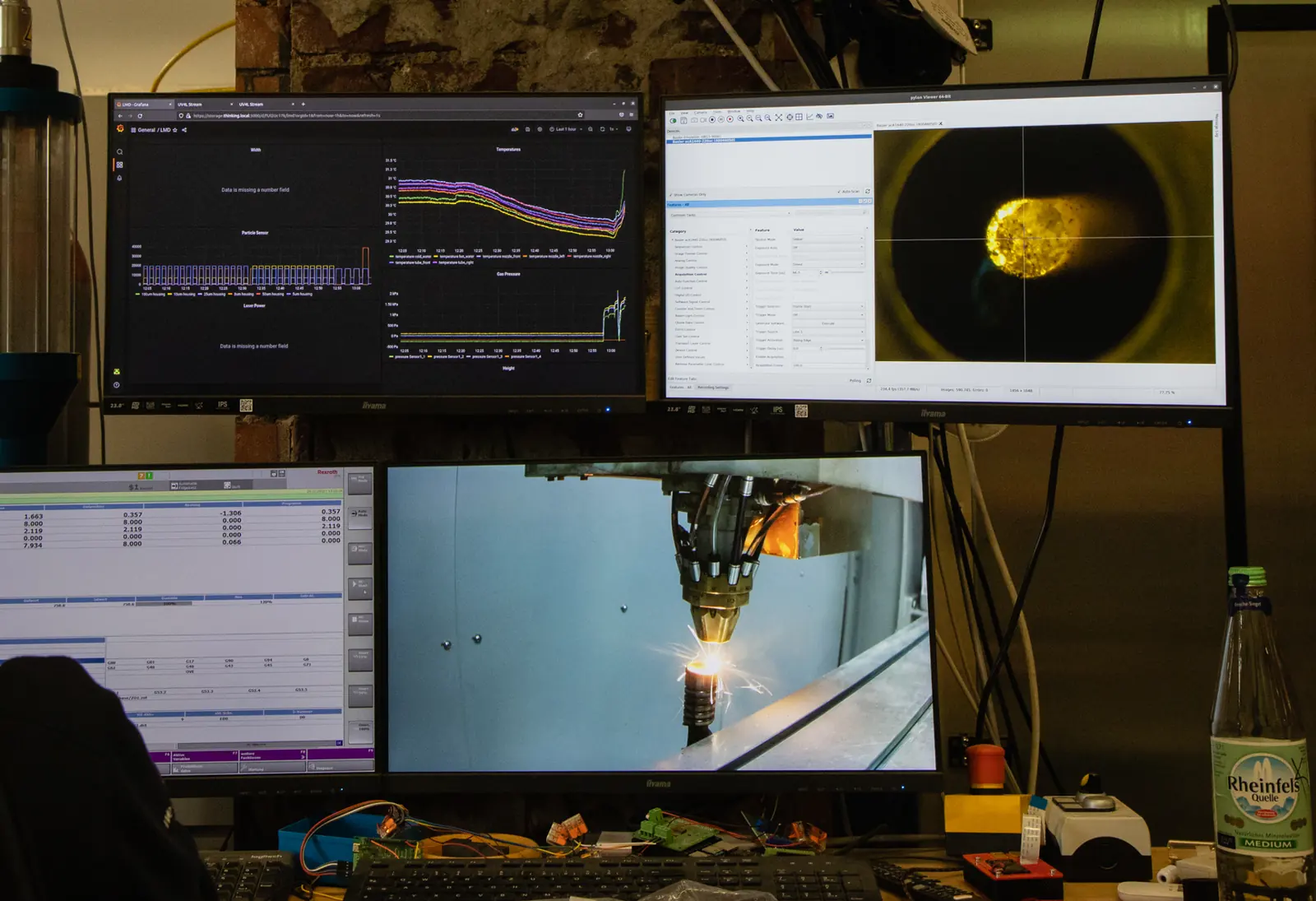
Functionally graded LMD is useful when one part may need different material behavior in different zones. An pipe demonstrator with a controlled material transition can show how Exafuse thinks about multi-material deposition, interface quality and validation without turning the page into a confidential process recipe.
Why a graded pipe is a useful demonstrator
A pipe or tubular sample is easy for buyers to understand. It can represent a real industrial question: the inside, outside and transition zone may not need the same material behavior.
For example:
- the inner region may need corrosion or temperature resistance;
- the outer region may need wear resistance, strength or machinability;
- a surface zone may need a functional coating;
- the transition zone must be compatible enough to avoid a weak interface;
- the final part still needs finishing and inspection.
The value of the demonstrator is not the exact alloy recipe. The value is the method: define the functional zones, plan the material transition and validate the interface.
What functionally graded LMD means
In a standard single-material build, one powder route is used for the deposited geometry. In a functionally graded route, the material composition or layer strategy changes through the build or across a zone.
That can be useful when a part has more than one requirement:
- corrosion resistance in one zone;
- wear resistance in another zone;
- heat resistance near a process-facing surface;
- machinability in a finishing zone;
- toughness near the substrate;
- a gradual transition between materials rather than an abrupt interface.
The transition must be engineered. A gradient is not automatically better than a clean single-material choice.
Internal research workflow
The publication-ready workflow can be described like this:
- Define the pipe or tubular demonstrator geometry.
- Decide which functional zones matter and why.
- Select material families for each zone.
- Plan the transition strategy between materials.
- Deposit the sample with powder-fed LMD.
- Section the sample for metallographic review.
- Review the interface, dilution, porosity risk and microstructure.
- Add hardness or other property evidence where approved.
- Decide what can be transferred to a customer part and what still needs qualification.
This lets the website show research competence without publishing exact powder ratios, layer recipes or unapproved test values.
Material direction and problem links
Multi-material work should be tied to a functional reason.
Useful starting points:
- Materials overview for Fe-, Ni-, Co-, copper and carbide-reinforced family logic.
- Multi-material LMD guide for design and validation questions.
- 750 mm water-cooled nozzle proof for a public multi-material geometry story.
- Technology and equipment for process route context.
- Quality and inspection for validation planning.
What must be validated
For a graded pipe or multi-material LMD demonstrator, the important evidence usually includes:
- where the material transition starts and ends;
- whether the interface is continuous and free of obvious defects;
- dilution and mixing behavior;
- porosity or cracking risk near the transition;
- hardness or property profile where approved;
- final geometry and finishing allowance;
- whether the result is a research demonstrator, prototype or production-ready route.
The page should not imply that a research gradient is automatically ready for serial production. Each customer part needs its own geometry, material and acceptance review.
When a gradient may not be worth it
A functionally graded route may not be the best answer when:
- a single material already satisfies the duty;
- the transition creates more risk than value;
- the interface cannot be inspected;
- qualification cost is too high for the application;
- the geometry is better solved by separate parts, coating or conventional joining;
- the customer needs certified properties that have not been tested.
What to send for an R&D discussion
Send the target geometry, required material behavior by zone, base material or substrate, temperature or corrosion environment, wear or strength requirement, transition constraints, finishing needs, quantity, research objective and what evidence is required before the route can be used on a real part.
CTA
Send the material-zone idea, geometry and validation target for a multi-material LMD discussion.