
Functionally graded materials use a controlled transition between material compositions instead of one abrupt interface. In DED and LMD, that can be technically attractive when a single alloy is a compromise between substrate compatibility, wear resistance, corrosion resistance, or thermal behavior. The concept is powerful, but it belongs in a feasibility and qualification discussion, not in casual performance promises. In standards-style language, this sits inside DED-LB/M discussions, while German engineering teams may talk more directly about Funktionsgradienten or gradient layers.
What a gradient solves that a single alloy cannot
An abrupt material change can create a difficult interface. The substrate may want toughness and compatibility, while the outer surface needs wear or corrosion performance. A gradient aims to bridge those needs by changing composition in steps or along a controlled transition zone rather than forcing one material system to do everything.
Why DED and LMD are relevant for FGM work
Powder-fed DED and LMD are relevant because they build material bead by bead and layer by layer. In principle, that creates a route for changing composition during deposition. This is one reason the process family is discussed in advanced repair, transition-layer design, and multi-material development work.
That does not mean every multi-material idea is production-ready. The engineering burden is higher because the chemistry, process control, and validation route become more complex.
Public proof: 750 mm multi-material water-cooled nozzle
Exafuse has publicly shown a 750 mm water-cooled nozzle design manufactured by LMD with two Ni-based alloys: Inconel 625 for the inner structure and Inconel 718 for the outer structure and cooling ribs. The proof build was described as a 1.8 mm thin-walled structure with more than 1,070 layers and around 50 hours of uninterrupted printing.
That example is not a blanket promise that every multi-material part is production-ready. It is a strong public proof that material zoning, path planning, slicing strategy, powder delivery and layer-overlap control can become part of a real LMD feasibility discussion when the component function justifies the extra engineering work.
Where gradients can make sense
Gradient concepts can be attractive when a hard surface layer would otherwise be too abrupt for the substrate, when a corrosion-resistant outer zone needs a more compatible transition underneath, or when thermal mismatch makes a single interface risky. They can also be relevant in advanced repair concepts where the deposited zone has to bridge different property demands across thickness.
Qualification is the hard part, not the concept diagram
FGM discussions fail when they stop at the materials idea and ignore the release plan. A gradient changes dilution behavior, microstructure, interface logic, and inspection requirements. The result may be promising, but it still has to be proven with the same rigor as any other high-consequence deposition route.
What this means in practice
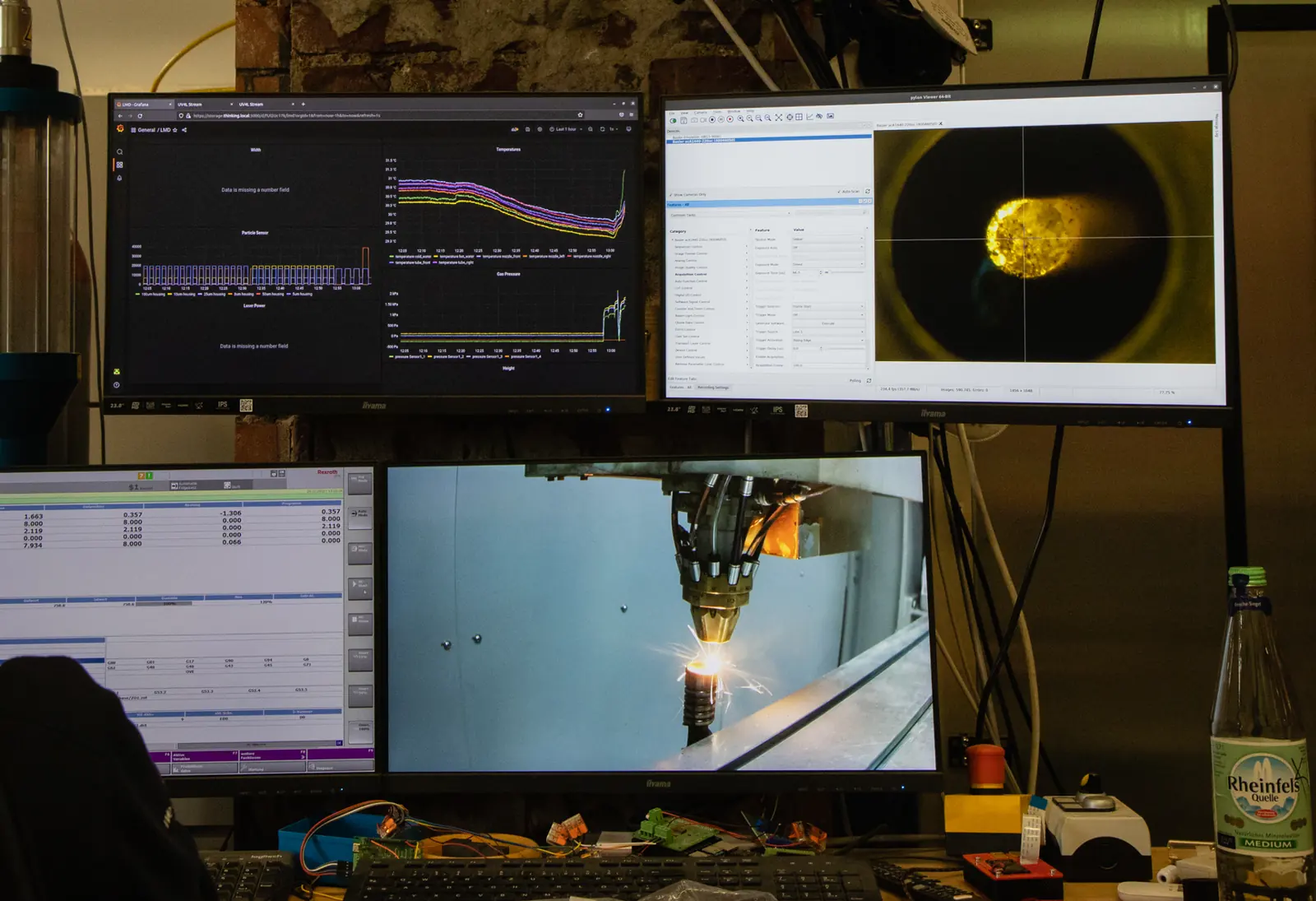
A multi-feeder DED or LMD setup can support development work for multi-material or gradient strategies. Exafuse's robotic system includes two powder feeders, which makes that development direction technically relevant. The practical point for buyers is that gradient work should be treated as a feasibility and qualification topic, not as a default production shortcut.
When an FGM is not the right answer
If a single alloy already solves the job, a gradient may add qualification effort without creating enough value. It can also be the wrong choice when the inspection route, service risk, or documentation burden does not justify the added complexity.
What to send for a gradient-feasibility discussion
Send the substrate material, the property conflict you are trying to solve, the expected service environment, and the geometry of the deposition zone. For multi-material part builds, also mark each material zone clearly and explain the function of each zone, such as corrosion resistance, strength, cooling, oxidation resistance or wear performance. It also helps to define whether the goal is wear, corrosion, thermal performance, bond compatibility, or some combination, because each of those points toward a different gradient strategy.