
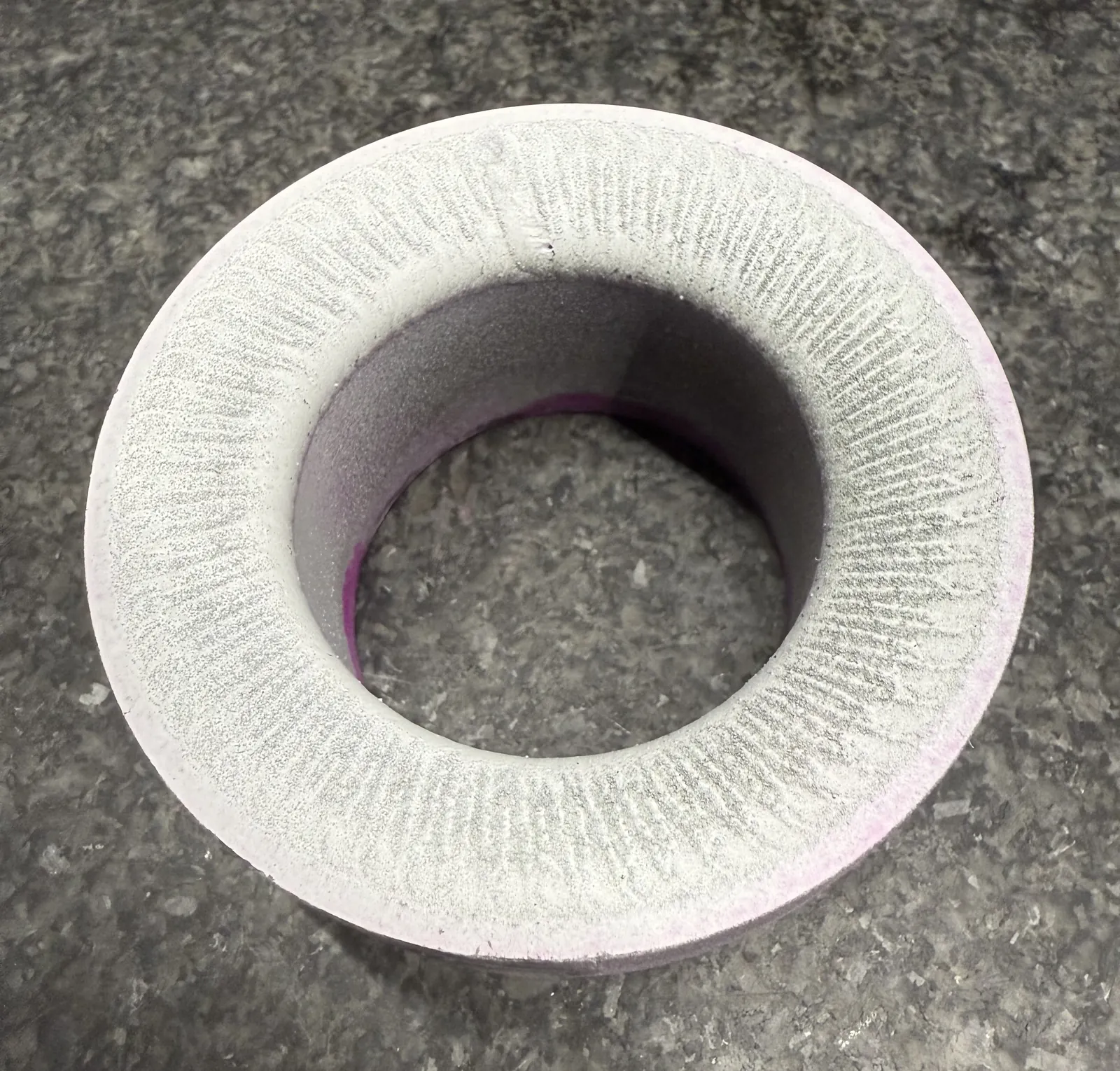
Exafuse has publicly shown a valve seat ring coating workflow using Laser Metal Deposition (LMD): preheating in an oven, controlled application in the LMD machine and a wear-resistant coating route for a hard surface duty. The useful buyer takeaway is not a generic promise that every hard coating is automatically crack-free. It is that hard wear-resistant coatings need a controlled process chain from substrate review to heat management, deposition strategy, finishing and inspection.
Who this article helps
This article is for industrial buyers and engineers who are evaluating laser cladding for wear-critical sealing, seating, sliding or contact surfaces.
It is most useful for:
- Maintenance teams dealing with worn valve seat rings, seats, sealing lands or contact surfaces.
- Procurement teams preparing an RFQ for a hard wear-resistant coating.
- Technical evaluators concerned about crack risk, dilution, preheating and inspection.
- OEM and plant engineers comparing replacement, conventional hardfacing and laser cladding.
- Buyers who know the surface needs better wear resistance but do not yet know the right material route.
What the valve seat ring proof shows
The public Exafuse video described a full coating journey for valve seat rings: the parts were preheated in an oven before precise application inside the LMD machine. The coating material was intentionally not disclosed publicly, but it was described as highly wear-resistant.
For buyers, the proof story is useful for three reasons:
- Wear-critical component logic: valve seat rings are a clear example of surfaces where local wear protection can matter more than coating the whole part.
- Heat-management logic: preheating is part of the story because hard coatings and sensitive substrates can create cracking risk if the thermal route is wrong.
- Process-chain logic: the result depends on preparation, deposition, cooling, finishing and inspection, not only on the powder name.
The safe claim is specific: Exafuse publicly showed a crack-controlled valve seat ring laser cladding example with a hard wear-resistant coating route. Similar parts still need review before coating feasibility or release quality can be claimed.
Why valve seat rings are a practical cladding example
Valve seat rings and similar seat surfaces often fail locally. The failure may be abrasive wear, adhesive wear, erosion, hot wear, corrosion-assisted wear or repeated contact loading. In those cases, replacing the whole component or applying a generic coating may not be the best first discussion.
Laser cladding can be attractive when:
- the worn zone is local and accessible;
- the base component still has enough value to protect or restore;
- the required layer should be metallurgically bonded;
- a harder or more wear-resistant surface is needed only in a defined zone;
- the final seating surface can be finished after deposition;
- inspection criteria can be agreed before processing.
The part still has to be checked for base material condition, geometry, heat sensitivity and final acceptance criteria.
Why hard coatings create crack-risk questions
Hard wear-resistant coatings are useful because they resist damage. The same material behavior that makes them attractive can also make them more sensitive to cracking, dilution effects, residual stress or finishing difficulty.
Crack risk is influenced by:
- the base material and its carbon or alloy content;
- coating material family and hard phases;
- dilution between substrate and deposit;
- preheating and cooling strategy;
- layer thickness and overlap;
- part geometry and restraint;
- machining or grinding allowance;
- inspection method and acceptance criteria.
That is why a serious laser cladding offer should not say only "harder coating." It should explain how the material, heat route and validation plan fit the component.
The role of preheating
Preheating can reduce thermal gradients and help manage cracking risk in selected laser cladding jobs. The public valve seat ring proof included oven preheating before LMD coating, which is exactly the kind of process-chain detail buyers should look for.
Preheating is not a universal fix. It has to be matched to the substrate, coating material, geometry and the accepted heat input for the part. In some projects, additional cooling control, post-heating, finishing or inspection may also be needed.
The important point is that temperature management belongs in the engineering discussion before deposition starts.
Why the exact material may stay confidential
The public post intentionally did not disclose the exact coating material. That is acceptable for marketing, as long as the website does not turn the hidden material into an unsupported claim.
Public wording can say:
- a highly wear-resistant material was used;
- hard coatings need crack-risk management;
- material selection is tied to substrate, failure mode and validation;
- exact alloy recommendations are project-specific.
Public wording should not say:
- the exact material family unless approved;
- a hardness value without approval;
- that the same coating is suitable for every valve seat;
- that every hard coating will be crack-free.
Process chain for a valve seat ring coating review
A practical coating review usually follows this route:
1. Failure-mode review
The first question is what damaged the seat surface: abrasion, sliding wear, erosion, corrosion, hot wear, impact, repeated contact or a mixed mechanism.
2. Substrate and geometry check
The base material, current condition, ring dimensions, access and final seating requirements define whether LMD coating is practical.
3. Material direction
The coating route is selected by duty. Fe-based, Ni-based, Co-based, carbide-reinforced or other hard wear-resistant directions may be discussed depending on the part and approval boundary.
4. Heat-management plan
Preheating, cooling strategy and layer planning are reviewed where crack risk, residual stress or heat-affected-zone behavior matter.
5. LMD coating and finishing
The coating is deposited by LMD and then finished as required. For valve seats, final geometry and surface condition often matter as much as the deposited layer itself.
6. Inspection and documentation
Inspection may include dimensional checks, surface crack checks, microscopy, metallographic preparation, hardness evidence or other agreed methods depending on release risk.
When this route is a good fit
Valve seat ring laser cladding is worth evaluating when the value is in a local working surface rather than a full new part.
Fit signals include:
- repeated wear on the same seat or sealing zone;
- high replacement cost or long replacement lead time;
- need for a metallurgically bonded hard surface;
- access for LMD deposition and later finishing;
- known base material or a route to identify it;
- enough part value to justify coating, finishing and inspection.
When it is not the shortcut
Laser cladding may not be the right first route when:
- the base part is cracked, heavily damaged or unknown;
- the seat geometry cannot be accessed or finished after coating;
- the part is cheap and replacement is faster;
- the required coating is non-metallic;
- the buyer wants only a hardness value without defining the failure mode;
- crack inspection or release criteria cannot be agreed.
The better technical answer may be replacement, redesign, conventional machining or a different coating route.
What to send for a valve seat ring coating review
Send:
- photos of the worn seat ring or seating surface;
- drawing or CAD if available;
- base material if known;
- ring dimensions and coated-zone dimensions;
- wear mechanism or service history;
- operating temperature, media, lubrication and load condition;
- target final geometry and surface finish;
- whether preheating, heat treatment or post-machining is allowed;
- quantity and target lead time;
- required inspection or documentation.
If the coating material must stay confidential or is already specified by an internal standard, say that early. It changes how the feasibility review should be framed.
Recommended next steps
Start with the pages and tools that match the coating decision:
- Laser cladding for wear-resistant surface layers.
- Material selector for an early alloy-family direction.
- Materials for Fe-, Ni-, Co- and hard-phase selection logic.
- Alloy selection for laser cladding for material tradeoffs.
- Failure modes to cladding solutions for damage-to-layer mapping.
- Metallurgical validation for bond, dilution and microstructure questions.
- Inspection stack for crack, geometry and documentation planning.
- RFQ builder to package the request.
Send a coating recommendation request
Send the component photos, base material, wear mechanism, surface zone, final geometry and inspection expectations. Exafuse can review whether LMD laser cladding is a practical route for the valve seat ring or similar wear-critical surface.
FAQ
Can LMD coat valve seat rings?
It can be evaluated. Exafuse has publicly shown a valve seat ring laser cladding example with preheating and a hard wear-resistant coating route. Feasibility still depends on substrate, geometry, access, heat management, finishing and inspection.
Does preheating prevent cracking?
Preheating can help manage thermal gradients and cracking risk in selected jobs, but it is not a universal guarantee. The correct heat route depends on the substrate, coating material, geometry and acceptance criteria.
Can Exafuse disclose the exact coating material?
The public proof story kept the exact material confidential. For a real project, material disclosure depends on customer requirements, internal approvals and whether a specific alloy must be named in the quote or documentation.
Is a harder coating always better?
No. Hardness alone does not prove service life. A coating must match the failure mechanism, substrate, toughness requirement, finishing route and inspection plan.
What makes a hard laser-clad coating credible?
A credible coating route defines the failure mode, material direction, heat-management plan, finishing allowance and inspection criteria before deposition starts.