Metallurgical validation for laser cladding should prove that the deposited layer is bonded correctly, that dilution is acceptable for the job, and that the resulting microstructure and heat-affected zone match the performance target. In other words, a clad layer is not validated because it "looks good" on the surface. It is validated when the bond, chemistry, structure, and geometry make technical sense for the application.
What metallurgical validation needs to prove
The first question is whether the deposited material is metallurgically bonded to the substrate instead of sitting on the surface like a mechanically attached coating. The next question is whether the interface chemistry and structure are still acceptable once base material mixing, heat input, and cooling are taken into account. That is why validation usually looks at bond condition, dilution, microstructure, cracking risk, porosity risk, and the heat-affected zone rather than relying on one headline number.
Bonding is different from simple adhesion
Laser cladding and Laserauftragschweißen are valued because they create a metallurgical bond. That matters because service performance often depends on how the overlay and substrate behave together under load, temperature, and wear. A layer can be hard and still fail if the interface is weak, contaminated, or stressed in the wrong way.
For that reason, validation should include interface-focused evidence. Cross-sections, microscopy, dimensional checks, and agreed inspection methods each answer part of the bond question. The exact stack depends on the criticality of the part.
Dilution changes the chemistry at the interface
Dilution describes how much of the base material mixes into the deposited layer. That is important because the final chemistry in the bonded zone is not identical to the nominal powder chemistry. Too much mixing can shift hardness, corrosion resistance, hot-hardness behavior, cracking tendency, or wear performance away from what the buyer expected.
Dilution is therefore not a niche research topic. It is one of the main reasons why the same powder can perform differently on different substrates or under different process conditions. Buyers who care about final properties should care about interface chemistry as much as the powder label.
Microstructure and HAZ depend on both alloy and substrate
Microstructure in the clad zone is shaped by the alloy system, the substrate, the thermal cycle, and the geometry being processed. The heat-affected zone matters because the substrate also changes during deposition. Depending on the job, that can influence hardness transitions, residual stress, crack sensitivity, or the way the rebuilt area responds to later machining and service loads.
This is why substrate compatibility belongs in the qualification conversation from the start. A technically good validation plan does not only ask, "What powder do we want?" It also asks, "What base material are we depositing onto, and what happens at the interface?"
Public proof: crack-risk control in hard coatings
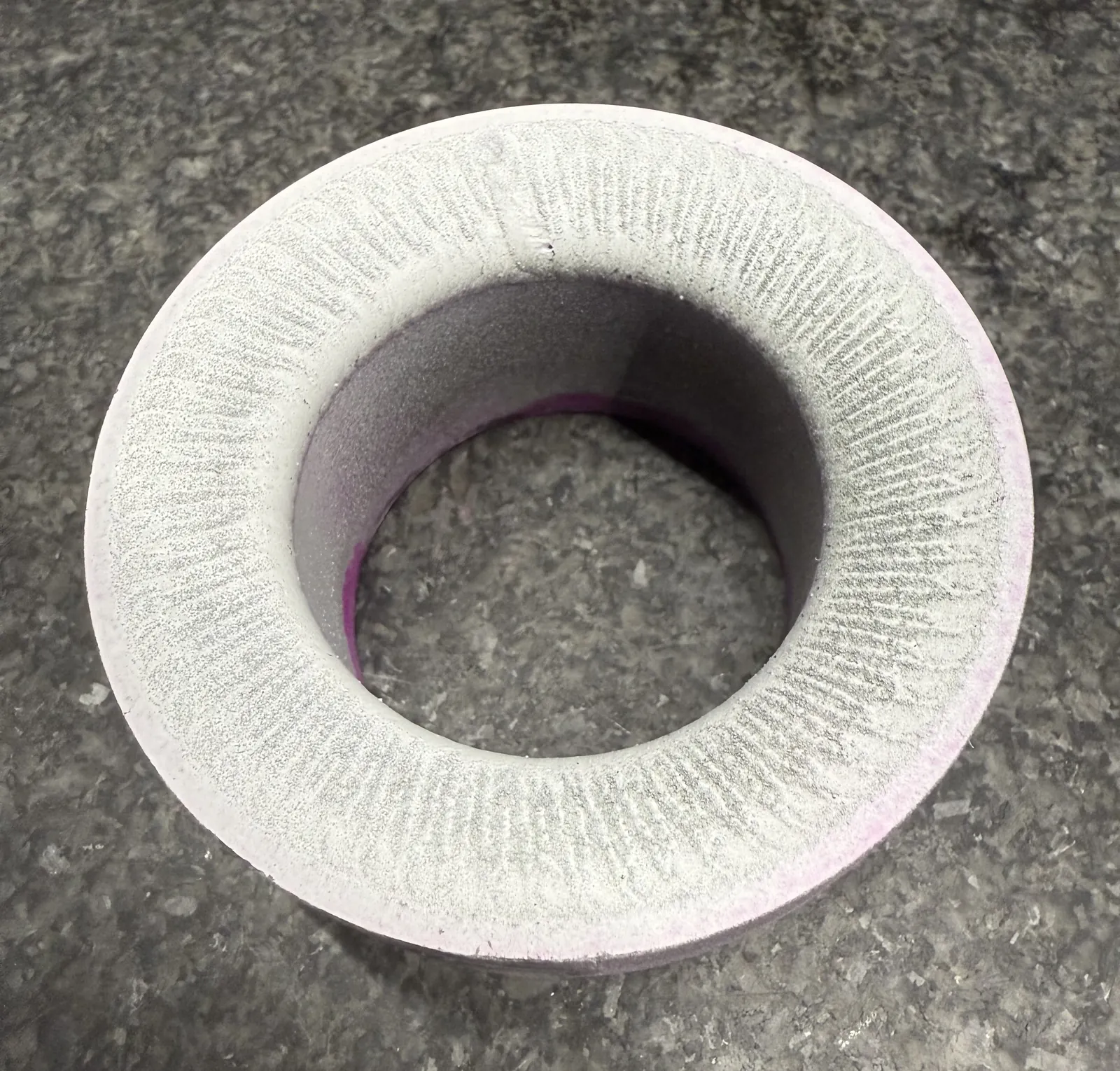
Exafuse has publicly shown a valve seat ring laser cladding workflow that included oven preheating before LMD coating with a hard wear-resistant material. This is a useful validation example because hard coating work is often limited by cracking risk, dilution behavior, residual stress and finishing requirements.
The claim should stay specific. The public proof supports discussion of crack-risk management in a valve seat ring coating workflow. It does not prove that every hard coating, every substrate or every geometry will be crack-free without project-specific validation.
Public proof: forging hammer bond and impact duty
Exafuse has publicly described LMD-enhanced forging hammer repair work where metallurgical bonding and application-specific alloy strategy are central to the repair logic. For validation, this is useful because high-impact tooling cannot be judged only by surface appearance or hardness. The bond, dilution, heat-affected zone, toughness, crack condition and final geometry all matter under repeated loading.
Hardness is useful, but it is not the whole answer
Hardness testing can support a validation plan, especially when wear resistance or a hardness gradient matters. But hardness alone does not prove bond quality, internal soundness, crack absence, or dimensional acceptability. It is one data point inside a broader release decision.
Where hardness is relevant, the useful question is not whether one impressive value exists. The useful question is whether the hardness profile and the surrounding metallurgical evidence match the application and the agreed acceptance logic.
What can be checked in-house and what may need added scope
The confirmed approved claim is that Exafuse has in-house microscopy and metallographic preparation capability for evaluating surfaces, welds, cross-sections, and microstructure. That makes cross-section-based validation a credible part of the technical discussion. It should still be scoped to the job rather than assumed for every part.
Additional testing, specialist NDT, or laboratory work may be required depending on the part and the release risk. The inspection route should be defined early so validation evidence matches the decision the buyer actually needs to make.
What buyers should ask for in a validation checklist
The most useful checklist is short and part-specific. It should define the base material, deposited material family, critical surfaces or zones, bond-related risks, dilution sensitivity, dimensional requirements after finishing, and which inspection records are needed for release.
If a buyer wants a technically serious quote, the request should also include the service condition, damage mechanism if this is a repair or coating, and whether metallographic evidence, hardness checks, surface crack checks or external inspection will be part of acceptance. For forging hammers and other impact tools, include impact duty, expected contact surface, previous repairs and crack history. That turns metallurgical validation from a vague quality promise into an engineered scope.