
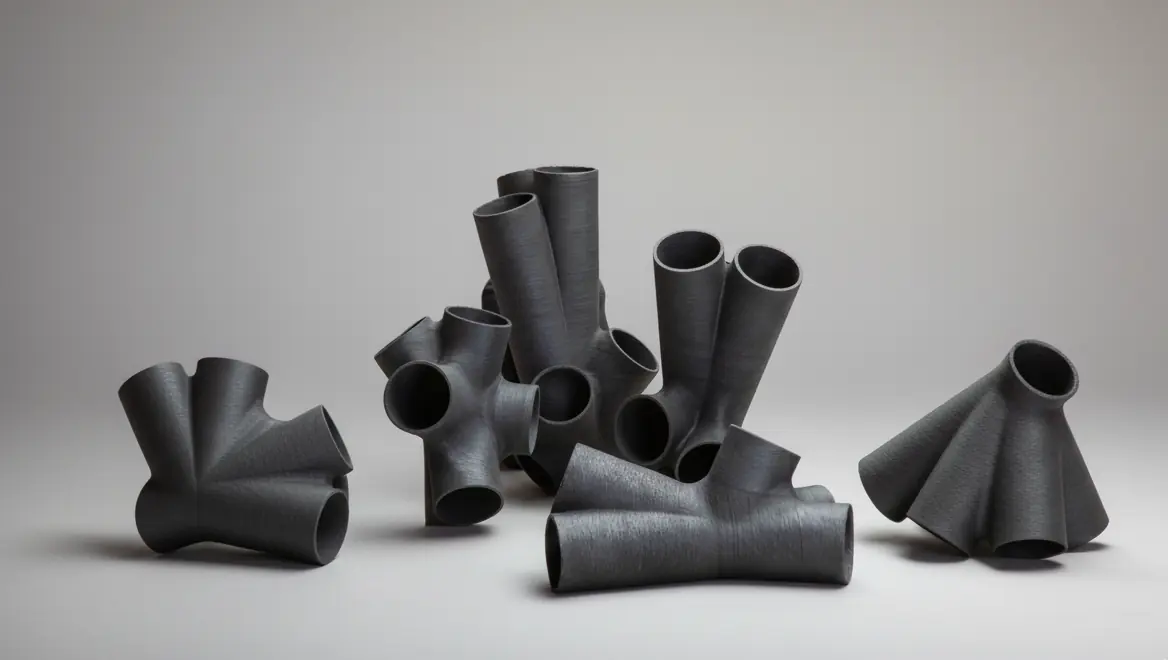
Exafuse manufactured more than 750 kg of metal components for a pedestrian bridge project in Duisburg using Laser Metal Deposition (LMD). The scope included structural nodes, also described as Knoten, and handrail components. This is the flagship Exafuse proof story because it connects large-format additive manufacturing, CAD redesign, production planning, process monitoring, validation and real infrastructure relevance.
Use A32: Large Structural LMD for Bridge Components as the generalized buyer guide.
Case snapshot
| Case element | Detail |
|---|---|
| Project type | Large structural metal components for a pedestrian bridge |
| Location context | Duisburg bridge project |
| Process | Laser Metal Deposition / LMD / DED-LB/M |
| Scope | Structural nodes and handrails |
| Total component mass | More than 750 kg of manufactured metal components |
| Large components | Individual components above 150 kg |
| Node production | Six structural nodes manufactured by LMD |
| Production proof | Knoten 10: 219 hours of printing and about 8 km of robot travel |
| Total node motion | Roughly 38 km of robot travel across six nodes |
| Parameter route | Optimized deposition around 0.8-1 kg/hour |
| Validation | Independent validation support from Karlsruhe Institute of Technology (KIT) |
| Buyer relevance | Large structural LMD from CAD redesign to production, monitoring and release planning |
Why this case matters
Many additive manufacturing proof stories stop at a sample, a coupon or a display part. The Duisburg bridge project is different. It shows LMD used for large, heavy and visually important structural components intended for a real bridge assembly.
That makes the case valuable for industrial buyers because it proves several things at once:
- Exafuse can handle large metal LMD components, not only small demonstration parts;
- architectural geometry can be adapted into manufacturable LMD geometry;
- process planning and parameter development can be tied to validation;
- long production cycles can be managed with monitoring and workflow discipline;
- LMD can support both structural nodes and related handrail components;
- production can be organized across different LMD machine routes when capacity and geometry require it.
The practical boundary is important. This is not a universal statement that every bridge component can be printed. It is proof that large structural LMD can be engineered when the design, process and validation route are treated as one project.
The challenge
The bridge components had to satisfy more than one requirement. They had to preserve the visual and architectural design intent, remain manufacturable by LMD, connect properly to other bridge elements and satisfy structural expectations.
The original node geometry was visually strong but not automatically optimized for large-format metal deposition. Overhangs, wall thickness, connection points and transitions had to be reviewed before manufacturing.
The practical challenge was to move from a sculptural digital model to a manufacturable and inspectable metal part.
CAD redesign for manufacturability
Exafuse refined the CAD route so that the nodes could be manufactured efficiently with LMD while preserving the design intent.
The redesign work included:
- reducing printability problems from overhangs and unsupported features;
- optimizing wall thickness for weight, strength and thermal stability;
- refining connection points for later integration;
- smoothing surface transitions for better part quality;
- coordinating changes with structural simulation and validation.
In the project, selected wall-thickness refinements moved from 10 mm to 11 mm, with reinforcement to 14 mm in higher-load areas. That is a project-specific design-for-manufacturing example, not a general bridge design rule.
Path planning and deposition strategy
For the bridge nodes, standard toolpath generation was not enough. Exafuse developed a G-code post-processing workflow to improve the deposition path for complex large geometry.
The process-planning goals were:
- avoid overlapping deposition zones that could increase weak-point or porosity risk;
- adapt path strategy to geometry and material flow;
- optimize tool angles for consistent material deposition;
- improve material distribution;
- reduce downtime and bottlenecks during production.
This is one of the strongest technical lessons of the case. In large LMD, the toolpath is not just a machine instruction. It is part of the quality route.
Parameter development and Knoten 19
Knoten 19 was an important parameter-development milestone. It was produced twice using different parameter sets.
The first iteration did not fully meet the required mechanical property target. Exafuse analyzed the material microstructure, refined path-planning strategy and developed an improved parameter route. The second iteration became the breakthrough for the project production route.
The optimized route reached a reported deposition rate of 0.8-1 kg/hour while balancing strength, density and production efficiency.
This is not a generic promise that every large LMD part can be produced at that rate. The buyer lesson is that the deposition rate was reached after process development and validation.
Independent validation
After parameter optimization, Knoten 19 was sent for independent validation at Karlsruhe Institute of Technology (KIT).
The validation context included:
- microstructural review;
- mechanical testing against project requirements;
- assessment of the optimized LMD process route;
- confirmation that the final material route met the project specification.
Exact property values belong in the approved test record. The important public message is that the project used an evidence route, not just internal confidence.
Process monitoring and data
The bridge production route used monitoring and process analytics to support production reliability.
The wider component effort included:
- melt-pool monitoring;
- powder blockage detection;
- protection-glass breakage detection;
- multi-camera monitoring;
- sensor-based process analytics;
- AI-assisted process understanding and predictive maintenance direction.
The strongest data point is that more than one million melt-pool images were collected and analyzed during production. This gives Exafuse a credible monitoring story: the data supports process understanding, future defect detection and process improvement. It does not replace inspection or guarantee final quality by itself.
Printing the structural nodes
The six bridge nodes were a major production effort.
The production route included:
- Knoten 10 as a milestone with 219 hours of printing;
- about 8 km of robot travel for Knoten 10 alone;
- roughly 38 km of robot travel across all six nodes;
- nearly 1,000 hours of machine time for node production;
- deposition rates in the 0.8-1 kg/hour range;
- workflow optimization that reduced print time by nearly 20 percent by the final node;
- completion of the node production path about one month ahead of schedule.
The scale is easy to understand: the robot path across the six nodes was roughly the distance from Bochum to Duisburg.
Printing and joining the handrails
The handrails required a different manufacturing strategy.
The robotic LMD system was focused on node production, so Exafuse adapted the 3-axis LMD system for handrail work. Because the handrail geometry included curves and overhang challenges, the team segmented each handrail into three parts and produced joining sections with LMD.
The handrail route included:
- segmenting the design for manufacturability;
- optimizing orientation to avoid unnecessary support structures;
- producing joining sections by LMD;
- aligning and joining the segments;
- checking bonding and dimensional accuracy.
This part of the case is useful because it shows production flexibility. The same project used robotic LMD for structural nodes and 3-axis LMD strategy for handrail components.
Final inspection and completion
Before shipment or integration, the components were checked against project expectations.
The production route included:
- weight verification using a high-precision scale;
- dimensional checks;
- independent validation connected to the Knoten 19 parameter route;
- final completion of nodes and handrails after months of engineering and production.
This is project-specific quality planning. Similar structural LMD jobs still need their own inspection stack and release logic.
Result framing
The result is a flagship Exafuse proof story:
Exafuse manufactured more than 750 kg of LMD bridge components for a Duisburg pedestrian bridge project, including six structural nodes and handrails. The work combined CAD redesign, deposition-path development, parameter optimization, process monitoring, production workflow improvement, independent validation and final inspection.
This is not only a large print story. It is a CAD-to-production story for structural metal additive manufacturing.
What buyers can learn
This case shows that large structural LMD projects need:
- early CAD-for-manufacturing review;
- agreement on which geometry can be changed;
- deposition strategy and path-planning control;
- parameter development before full production;
- monitoring and process data for long builds;
- realistic production scheduling;
- finishing and assembly planning;
- validation evidence before release;
- clarity about what can be published and what remains project-confidential.
What to send for a similar project
Send:
- CAD model and drawings;
- target material or alloy family;
- maximum dimensions and approximate part mass;
- structural function and safety-critical zones;
- architectural or visual requirements;
- assembly interfaces and partner requirements;
- acceptable design-change window;
- quantity and schedule;
- required validation, testing and documentation;
- public-reference permissions for project names, images and partners.
Related article
Use A32: Large Structural LMD for Bridge Components as the generalized article for buyers evaluating similar projects.
Useful related pages:
- Metal AM for the manufacturing service route.
- Technology and equipment for LMD machine capability.
- Quality and inspection for evidence planning.
- A06: LMD for large metal parts.
- A04: LMD vs SLM.
- A12: Monitoring and control in LMD.
CTA
Send CAD, material, approximate mass, structural function, finishing needs and validation expectations for a large structural LMD review.