
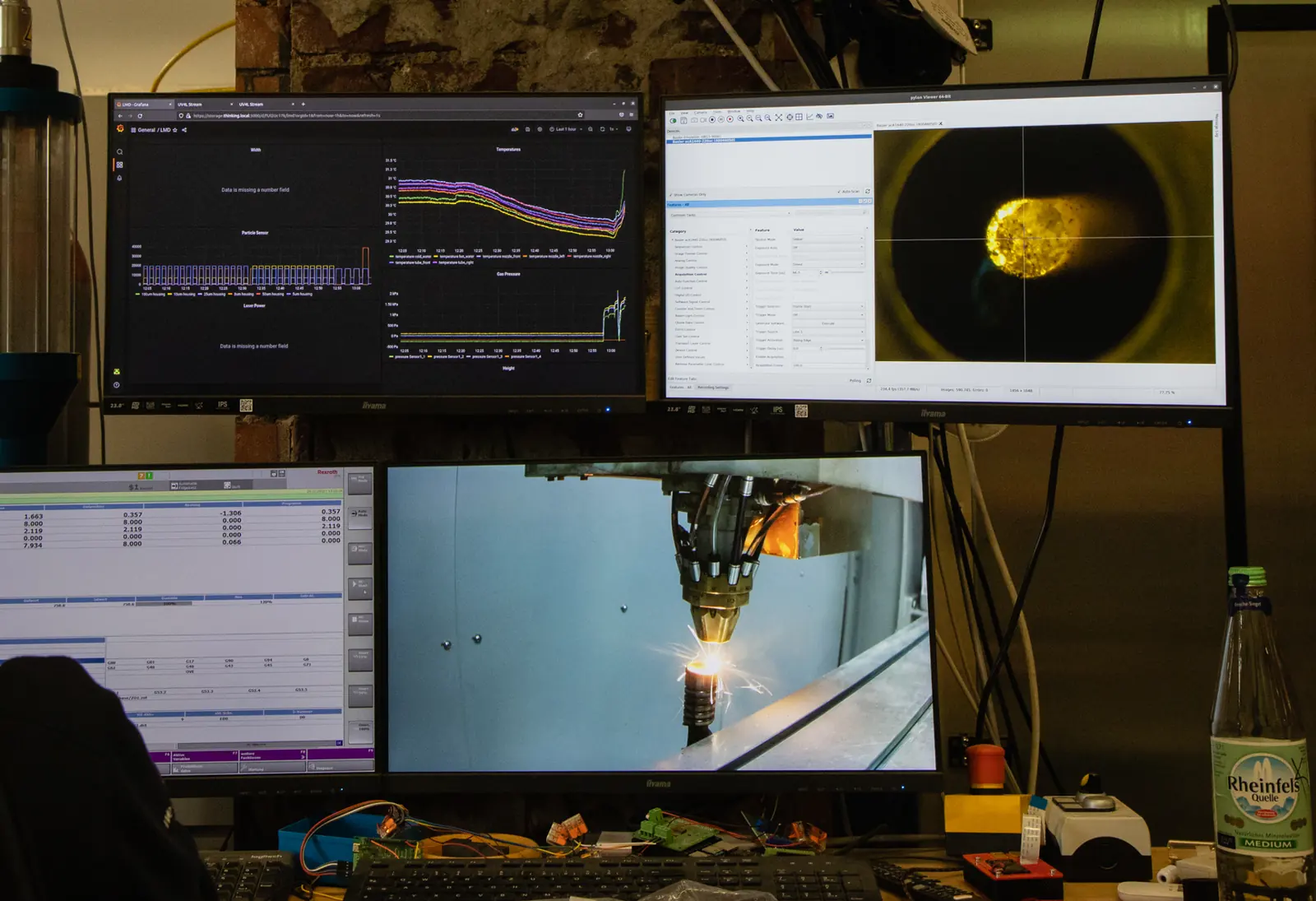
AI in Laser Metal Deposition should be discussed in levels. A model that helps engineers review process images is not the same as a closed-loop system that automatically changes laser power, powder flow or travel speed during production. For customer-facing communication, that distinction is essential.
The short answer
AI can support LMD by helping teams interpret process data, detect patterns, compare parameter windows and prepare better control strategies. Closed-loop control claims require stronger evidence: what is measured, how the model responds, which process variable is changed and how the result is validated on the part.
Why LMD control is difficult
LMD is sensitive to geometry, substrate condition, powder behavior, heat accumulation, layer history, access angle and finishing requirements. The same parameter set can behave differently when the part geometry or local thermal state changes. That is why AI work should be connected to process physics and validation, not treated as a generic software layer.
Useful levels of AI support
The safest public structure is a progression: offline process analysis, operator decision support, parameter-window development, anomaly screening and then, only where validated, adaptive or closed-loop control. Each level needs a different evidence standard.
What signals can feed an AI model
Potential inputs include melt-pool images, thermal signals, machine state, path position, layer number, powder delivery context and inspection outcomes. A model becomes more useful when it can connect process signals to a specific engineering question, such as stability, geometry risk, heat buildup or defect-risk evaluation.
Why inspection still matters
AI does not remove the need for inspection. Model outputs need ground truth: dimensions, cross-sections, microscopy, surface inspection, hardness where relevant and documented release criteria. Without that connection, AI can become a confident-looking dashboard rather than a qualified process tool.
publication-ready wording for Exafuse
Exafuse can present AI-assisted process control as a research and development direction around LMD process understanding. The page should avoid unsupported autonomy, defect-prevention, metric or certification claims unless those claims are approved for publication.
What buyers should ask
Instead of asking whether a supplier uses AI, ask what signal is monitored, what the model is trained to detect, how false positives and false negatives are handled, what action the model supports and what inspection evidence confirms the result. Those questions create a serious process-control discussion.