
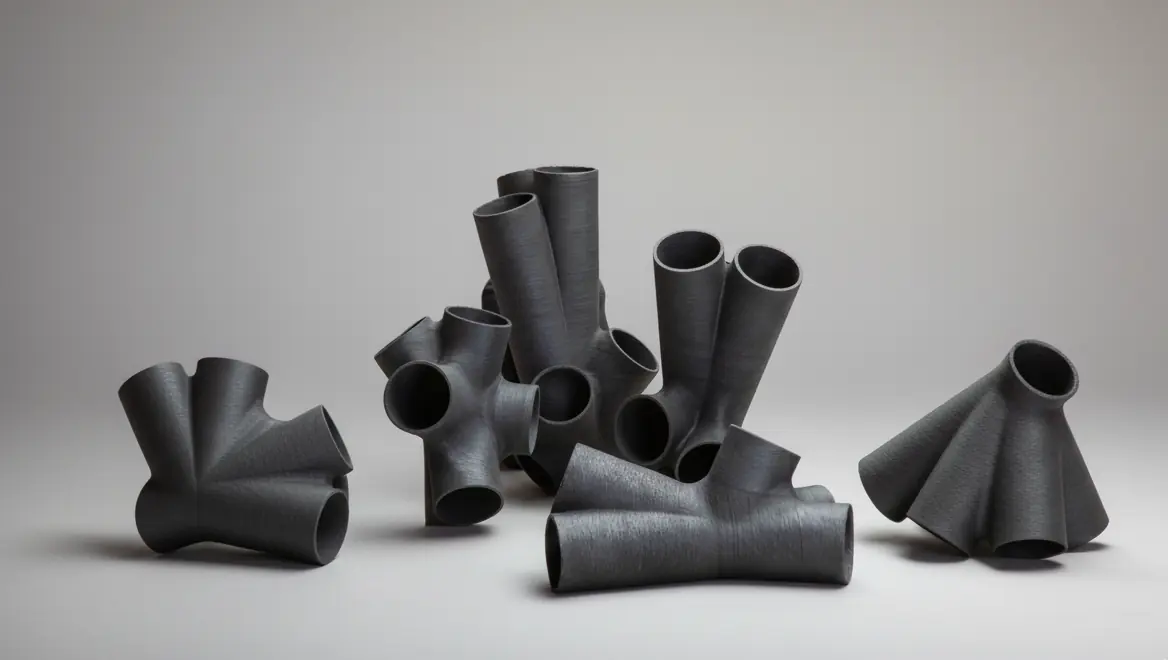
Large structural Laser Metal Deposition (LMD) is not only a larger print job. It is a full engineering route that connects CAD redesign, deposition strategy, parameter development, monitoring, production planning, finishing and validation. The Duisburg bridge component project is Exafuse's strongest public proof point for this: more than 750 kg of LMD-manufactured bridge components, including structural nodes and handrails, were taken from digital design into production-ready metal parts.
For the detailed proof page, use CS15: Duisburg bridge components with LMD.
Who this article helps
This article is for industrial buyers, architects, civil engineering teams, OEMs and technical evaluators who want to understand when LMD can be considered for large structural metal components.
It is most useful when the part is:
- too large, heavy or specific for conventional powder-bed additive manufacturing;
- too complex or material-intensive for simple machining from billet;
- structurally relevant and therefore dependent on validation;
- visually important as well as functional;
- part of a public infrastructure, architectural or heavy industrial assembly;
- dependent on a clear manufacturing route before the final RFQ.
Direct answer
LMD can be evaluated for large structural components when the part geometry, material route, deposition strategy, finishing route and validation scope can be planned together. The technology is strongest when the value is in large metal build-up, near-net-shape production, design adaptation, material efficiency or local feature creation. It is not a shortcut around engineering approval. For structural use, CAD changes, simulation, testing, dimensional checks and independent validation can matter as much as deposition itself.
The Duisburg bridge project shows the complete pattern: design adaptation, LMD process planning, parameter development, process monitoring, production optimization, handrail segmentation, inspection and external validation.
Why bridge components are a serious LMD proof point
Bridge components create a stricter question than many demonstration parts. The parts must connect real assembly interfaces, carry structural expectations, preserve a visible design intent and pass validation. That makes the project useful for buyers because it shows the practical workflow behind large-format metal additive manufacturing.
The public proof points include:
- more than 750 kg of LMD-manufactured bridge components;
- structural nodes, also described as Knoten, and handrail components;
- individual components above 150 kg;
- six structural nodes produced by LMD;
- a node production path that included nearly 1,000 machine hours;
- one major node, Knoten 10, with 219 hours of printing and about 8 km of robot travel;
- roughly 38 km of robot travel across the six nodes;
- deposition rates in the 0.8-1 kg/hour range during the optimized route;
- handrails produced in parallel by adapting the 3-axis LMD route;
- independent validation support from Karlsruhe Institute of Technology (KIT).
Those numbers should be treated as project proof, not as universal delivery promises for every structural part.
The engineering route behind the project
1. CAD redesign for manufacturability
The first challenge was not printing. It was turning architectural geometry into manufacturable LMD geometry without losing the design intent.
The redesign work included:
- adjusting overhangs and unsupported geometry;
- optimizing wall thickness for strength, weight and thermal stability;
- refining connection points for assembly;
- smoothing surface transition areas;
- coordinating design changes with structural validation.
In one source example, some sections were increased from 10 mm to 11 mm, while higher-load regions were reinforced to 14 mm. That is the key buyer lesson: even small CAD changes can matter when manufacturability and structural duty have to meet.
2. Path planning and G-code post-processing
Large LMD parts need more than a toolpath exported from software. Exafuse developed a post-processing workflow to improve the deposition strategy for complex bridge geometry.
The goal was to:
- prevent overlapping deposition zones that could increase defect risk;
- adapt the path strategy to part geometry and material flow;
- manage tool angles on complex surfaces;
- improve material distribution and process repeatability;
- reduce production bottlenecks once the route was validated.
For buyers, this matters because large-part LMD quality is tied to motion strategy, deposition overlap and heat behavior. The toolpath is part of the manufacturing process, not an administrative file.
3. Parameter development and material validation
For large structural LMD, process parameters must balance deposition speed, density, mechanical properties and production efficiency.
The bridge source describes a clear optimization path. Knoten 19 was produced in two iterations with different parameter sets. After the first iteration did not meet the required mechanical property target, the team reviewed microstructure and process strategy, then produced a second iteration with improved parameters.
The finalized route reached a reported 0.8-1 kg/hour deposition rate while keeping quality and production reliability in view. Independent validation at KIT supported the final parameter route for the project.
The important buyer lesson is simple: parameter development is part of the project, not something that should be assumed from a brochure.
4. Monitoring and process data
Monitoring and analytics were a major part of the bridge production route. Monitoring included melt-pool observation, powder delivery checks, multi-camera views, sensor data and AI-assisted analysis for process understanding.
The strongest public data point is that more than one million melt-pool images were collected and analyzed during production. That supports process understanding, future defect-detection work and production reliability. It does not turn monitoring into a blanket guarantee of automatic quality.
5. Production optimization
The bridge project also shows that large-format additive manufacturing is a production-system challenge.
The wider component effort included:
- nearly 1,000 hours of machine time for the node production path;
- more than 1,200 hours of LMD machine operation across the wider component effort;
- workflow improvements that reduced print time by nearly 20 percent by the final node;
- completion of the node production path about one month ahead of the original schedule;
- parallel production of handrails while robotic LMD capacity was focused on the nodes.
The key lesson is that industrial LMD work improves when setup, monitoring, part transitions, path planning and production scheduling are treated as one system.
6. Handrail segmentation and joining
The handrails required a different route than the structural nodes. The robotic system was focused on node production, so Exafuse adapted the 3-axis LMD machine for handrail manufacturing.
The handrail strategy included:
- segmenting each handrail into three parts;
- optimizing build orientation to avoid support structures;
- producing joining sections with LMD;
- aligning and joining the segments;
- checking bonding and dimensional accuracy.
This is useful because it shows a practical hybrid production mindset inside LMD itself: one component family may need different machine strategies depending on geometry, overhangs, capacity and assembly logic.
When large structural LMD is worth discussing
Large structural LMD is worth discussing when:
- the component is large, heavy, customized or difficult to machine economically;
- design freedom matters but the part is outside compact powder-bed logic;
- near-net-shape production can reduce material waste;
- CAD redesign is possible before manufacturing;
- the project can support test coupons, parameter validation or independent checks;
- finishing, assembly interfaces and inspection can be planned early;
- the buyer accepts that structural release requires evidence, not only a printed part.
When another route may be better
Another route may be better when:
- the part is a standard catalog item and replacement is cheaper;
- structural validation cannot be planned or funded;
- CAD changes are not allowed but the original geometry is not manufacturable;
- the material route is fixed but not compatible with the intended LMD process;
- final machining, finishing or inspection access is impossible;
- the project expects certified structural performance without a qualification route.
What to send for a large structural LMD review
Send:
- CAD model and technical drawings;
- target material or alloy family;
- overall dimensions and approximate mass;
- structural function and critical load paths if available;
- areas where geometry can or cannot be changed;
- assembly interfaces and connection requirements;
- target finish, machining allowance and visual requirements;
- quantity and target schedule;
- validation, simulation, testing or documentation expectations;
- whether public project names, images or partner references can be used.
Recommended next steps
Start with:
- CS15: Duisburg bridge components with LMD for the flagship proof story.
- Metal AM service for new-build LMD, SLM and hybrid manufacturing.
- Technology and equipment for the 3-axis and robotic LMD capability context.
- Quality and inspection for validation and documentation planning.
- A06: LMD for large metal parts for large-part process logic.
- A04: LMD vs SLM for process selection.
- RFQ builder to prepare a structured request.
CTA
Send CAD, material, target dimensions, structural function, finishing needs and validation expectations for a large structural LMD feasibility review.
FAQ
Can LMD be used for bridge components?
It can be evaluated for bridge or structural components when geometry, material, deposition strategy, finishing and validation can be planned together. The Duisburg bridge component project is a public Exafuse proof point, but every structural component still needs project-specific engineering approval and evidence.
Is large structural LMD only about machine size?
No. Machine size matters, but the real project depends on CAD redesign, path planning, parameter development, heat management, monitoring, finishing and inspection.
Does LMD replace structural validation?
No. LMD is a manufacturing route. Structural validation, simulation, testing and release documentation still have to be defined by the project requirements.
What makes the Duisburg bridge project important?
It connects scale, public infrastructure relevance, CAD-to-production engineering, monitoring, independent validation and production discipline in one proof story. That makes it stronger than a simple demonstration print.
What should buyers ask before starting a similar project?
Ask which geometry can be redesigned, which material route is realistic, what validation evidence is required, how the part will be finished, and what inspection or documentation will be needed before assembly.