
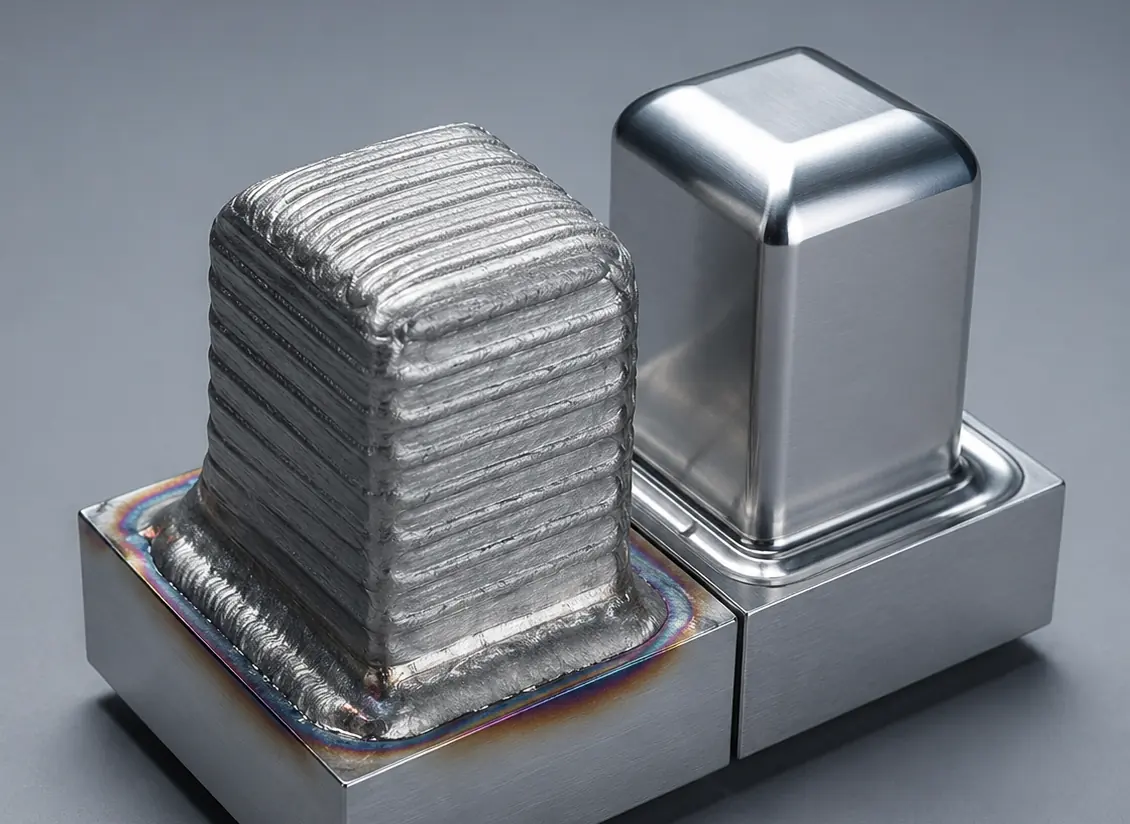
Hybrid manufacturing with LMD and CNC is often the practical route for large industrial parts. LMD adds material where it creates value. Machining, grinding, heat treatment, and surface preparation then bring the part back to the required interfaces, tolerances, and finish. That is not a compromise. It is usually the intended process plan. In German industrial language, the additive side of that route may also be described as Laserauftragschweißen when the job is really about controlled material addition rather than a stand-alone printed part.
Why LMD is rarely the final surface
LMD is strong at targeted material addition, near-net buildup, repair geometry, and local feature creation. It is usually not the final step for precision fits, sealing surfaces, or tight datum relationships. Treating the additive stage and the finishing stage as one combined manufacturing route leads to better outcomes than expecting the deposited surface to arrive at final tolerance by itself.
Start with the datum and stock plan
Hybrid success depends on knowing which surfaces will be rebuilt, which ones must remain reference surfaces, and how much stock should be left for finishing. If the datum strategy is unclear, machining risk goes up quickly because the deposit may not leave enough clean reference geometry for the next step.
The hybrid route changes by job type
For repairs, the sequence may be damaged-area preparation, local buildup, machining, and inspection. For new-build geometry, the route may be base structure, additive feature buildup, heat-management or thermal treatment steps, then finish machining. For coatings, the finishing need may be lighter but still important where thickness or surface condition matters.
Rapid prototype proof: powder to drill in 24 hours
Exafuse has publicly shared a rapid LMD proof story: a functional drill, described publicly as a "Bombenbohrer," produced from metal powder with an antimagnetic coating in under 24 hours together with ZIPP Industries GmbH & Co. KG. The useful lesson for hybrid manufacturing is that speed comes from coordinating the route early: deposition, coating logic, finishing and the first acceptance target have to be planned as one workflow.
This should not be read as a blanket 24-hour delivery promise. It is a strong example of what becomes possible when the part scope, material direction, surface function and deadline are clear enough for a focused prototype route.
Build-and-coat proof: 130 mm drill workflow
Exafuse has also publicly shown a 130 mm drill video where LMD was used for both fabrication and final surface coating. The coating was described as wear-resistant and anti-magnetic, from an alloy containing tungsten carbide.
For hybrid planning, the lesson is that the part is not finished when deposition stops. A useful route can include geometry build-up, functional coating, machining or grinding allowance and inspection evidence as one connected plan.
Post-processing is part of capability, not an afterthought
The approved capability picture is that Exafuse supports in-house post-processing steps including drilling or milling, grinding, sandblasting, plasma cutting, and heat treatment. That matters because hybrid manufacturing only works well when the finishing route is considered from the start. It should still be described conservatively, without implying a full machining capacity beyond what is actually confirmed.
Heat treatment and finishing sequence matter
Depending on the part, the order of deposition, thermal treatment, machining, grinding, and blasting can affect both dimensional recovery and inspection logic. The right sequence depends on the material system, geometry, and release requirements. There is no universal standard route.
Hybrid planning reduces tolerance surprises
Many tolerance problems do not come from the additive step alone. They come from poor coordination between deposition, fixturing, stock allowance, and finish machining. A hybrid plan that is defined early usually prevents those downstream surprises.
When hybrid is not worth the added complexity
Hybrid manufacturing is not automatically the right answer. If the geometry is simple, the part is small, or conventional machining from stock already solves the problem cleanly, adding an LMD step may create more process complexity than value. The route makes sense when targeted deposition reduces waste, avoids replacement, or makes a difficult geometry more manufacturable.
What to send for a tolerance and stock-allowance review
Send the CAD model or drawing, identify the surfaces that must be machined back to final tolerance, and specify which zones will be deposited or coated. It also helps to define the base material, the expected service loads, and whether heat treatment, coating or surface finishing is already part of the release plan. For urgent prototype work, also state the deadline, what the first part must prove and which tolerances or evidence can wait for a later iteration.