
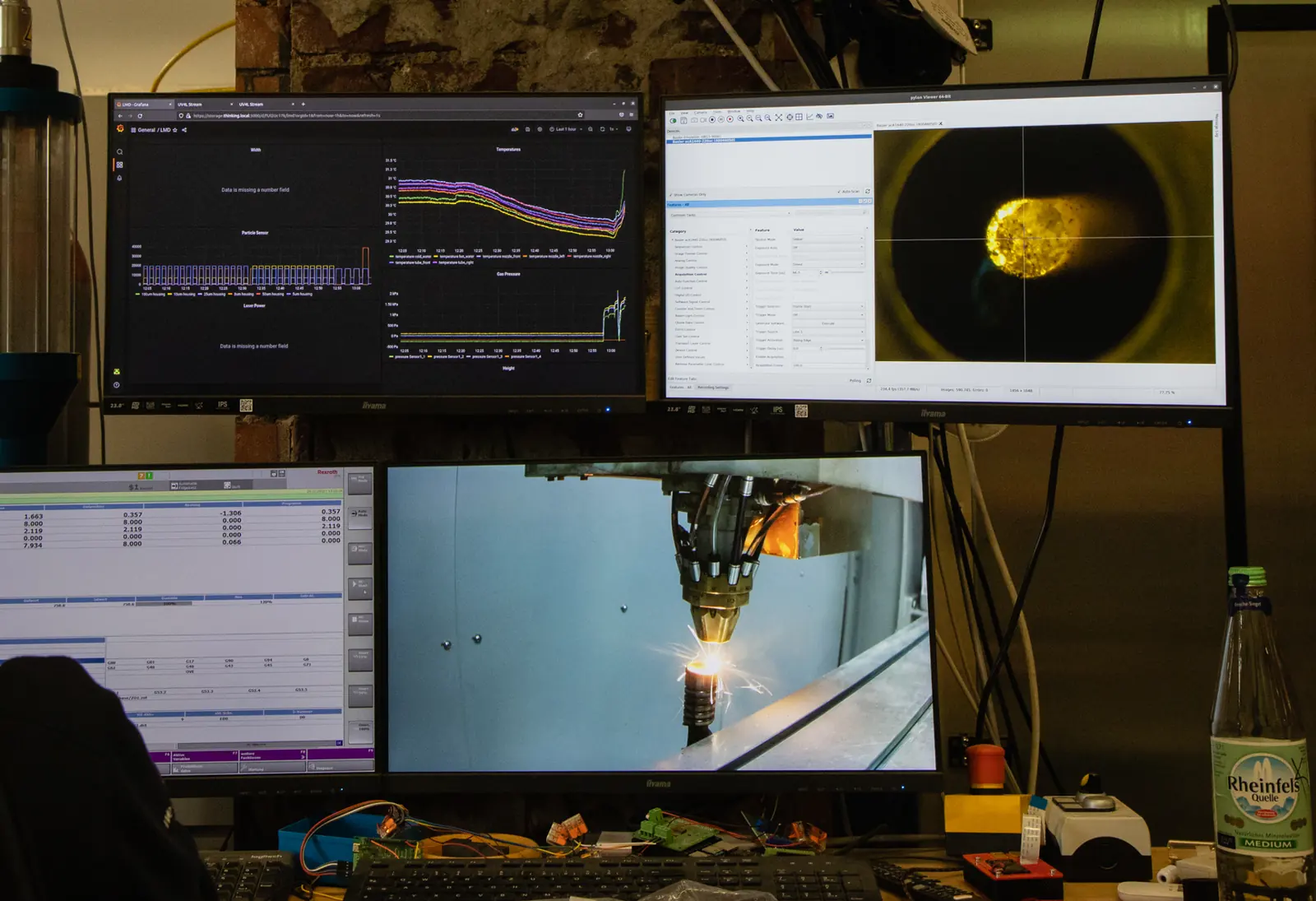
Neural-network image processing can make LMD monitoring data easier to interpret, especially when process images are noisy, reflective or hard to compare across builds. Pix2Pix-style models are one possible route because they learn image-to-image mappings from paired examples. The useful question is not whether the image looks convincing, but whether the output supports a validated engineering decision.
The short answer
Pix2Pix-style models can help translate LMD process images into segmentation maps, normalized views or analysis-friendly representations. They should be treated as research tools for interpretation and decision support, not as proof that the physical part meets quality requirements.
What Pix2Pix means in this context
Pix2Pix is commonly used to describe conditional image-to-image translation: an input image is mapped to a target image style or label representation. In LMD monitoring, the concept can be used for tasks such as separating the melt-pool region, reducing visual clutter, highlighting track-relevant zones or preparing images for downstream analysis.
Why LMD images are challenging
LMD process images can include bright reflections, powder plume, shielding effects, changing camera angle, smoke, spatter, surface texture and exposure differences. A neural network may learn useful visual structure, but it may also learn dataset-specific artifacts if the training data is too narrow or poorly labelled.
Where neural image processing can help
Useful research applications include melt-pool segmentation, anomaly screening, bead-boundary visualization, before/after image normalization, training-data preparation and comparison of process states across layers. These outputs are most valuable when they help engineers ask better questions earlier.
The main risk is hallucinated confidence
Image-to-image models can create plausible-looking outputs even when the input is ambiguous or outside the training distribution. That is why model output should not be treated as a measurement unless it has been validated for the specific task. For LMD, the model must be checked against process knowledge and inspection evidence.
How to validate the approach
A practical validation route includes labelled examples, holdout data, tests across different geometries and materials, comparison with human review, comparison with inspection outcomes and clear thresholds for when the model should not be trusted. The goal is to reduce ambiguity, not to hide it.
What this means for Exafuse content
For public pages, Exafuse should frame Pix2Pix-style image processing as part of AI-assisted monitoring research. Avoid publishing model metrics, training-set details, customer images or automatic-quality claims unless they are approved. The strongest public message is disciplined: image AI supports process understanding when it is validated against the real part.