
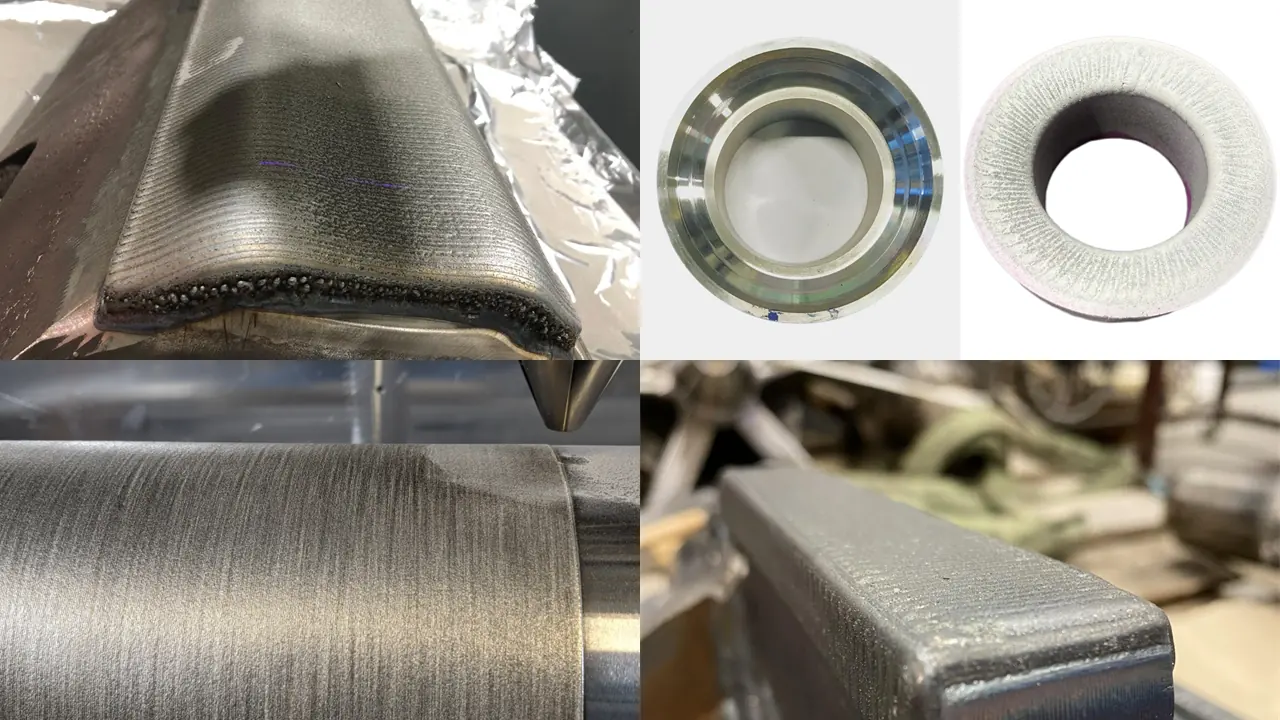
Laser Metal Deposition (LMD) coatings on copper or copper-alloy substrates need a different review than standard steel cladding. Copper conducts heat quickly and can reflect laser energy, so the coating route must manage absorption, temperature, dilution, layer uniformity, substrate integrity, finishing and inspection together.
For the specific Exafuse proof story, use CS14: Turbo generator rotor wedge coating with LMD. The case study is the right place for approved rotor wedge photos, process stills, temperature-control notes and CuNi2SiCr coating context.
Who this article helps
This article is for buyers evaluating whether LMD or laser cladding can improve a copper, copper-alloy or high-conductivity component.
It is most useful for:
- Energy and turbomachinery teams reviewing generator components or rotor wedges.
- Maintenance teams comparing coating, replacement and refurbishment routes.
- Procurement teams preparing RFQs for copper-substrate cladding.
- Engineers concerned about heat input, substrate integrity and layer uniformity.
- Technical evaluators who need a coating route that can be monitored and documented.
Direct answer
LMD coating on copper substrates can be evaluated when the surface needs improved wear, corrosion or functional performance and the substrate can tolerate the thermal route. The key technical issue is heat management. Preheating, absorption strategy, real-time monitoring, interpass control, layer plan, finishing and inspection should be defined before deposition starts.
This should not be treated as a simple "apply a better alloy" decision. Copper-substrate coating is a process-chain decision.
Why copper substrates are different
Copper and copper-rich alloys create practical coating challenges:
- high thermal conductivity pulls heat away from the melt pool;
- high reflectivity can affect laser energy absorption;
- the substrate may be sensitive to overheating or distortion;
- dilution and mixing behavior can affect the final layer;
- final conductivity, geometry or function may need to be preserved;
- inspection has to confirm the coating condition without assuming the surface is acceptable because it looks uniform.
For buyers, the right starting question is not only "Which coating material should we use?" It is "Can the substrate, coating material and heat route work together?"
Where CuNi2SiCr-type coating discussions fit
The supplied Exafuse rotor wedge proof uses CuNi2SiCr as the coating route. Public wording can describe this as a copper-alloy coating discussion for rotor wedge surface performance when approved.
For RFQ and technical review, the material conversation should include:
- base copper substrate condition;
- target coating function: wear resistance, corrosion behavior, conductivity, or a mixed requirement;
- coating thickness and uniformity requirement;
- final machining or finishing plan;
- temperature sensitivity of the substrate;
- documentation and inspection needs.
CuNi2SiCr is not a universal recommendation. Material choice remains part-specific.
Process chain to review
1. Component and duty review
Start with the component function, operating environment, wear or corrosion problem, and acceptance criteria. For turbo generator rotor wedges, the coating route should be tied to surface duty and substrate integrity.
2. Surface preparation and absorption strategy
Copper surfaces may need a planned preparation or preheating route so the laser process can couple energy into the surface consistently. The exact preparation method and number of preheat passes should remain project-specific unless approved for publication.
3. Temperature management
Temperature management is central. The process route may use monitoring, controlled pauses between tracks or seams, and a defined thermal window so the coating can be deposited without overheating the substrate.
4. Coating deposition
LMD applies the coating material locally. Track overlap, layer thickness, dilution, surface condition and heat accumulation all affect the final result.
5. Batch strategy
When multiple similar components are processed, batch planning can reduce total processing time. Parallel or alternating deposition across parts can help manage heat and improve throughput, but only when fixturing, monitoring and quality checks are planned.
6. Finishing and inspection
The coated surface may need final finishing, dimensional checks, visual inspection, metallographic review, hardness evidence, conductivity discussion or other project-specific documentation. The inspection plan should be matched to the duty of the component.
When this route is worth discussing
LMD coating on copper substrates is worth discussing when:
- the component is high value or difficult to replace;
- wear, corrosion or surface degradation is concentrated on defined zones;
- the substrate material and thermal sensitivity are known;
- a coating material can be selected around both performance and compatibility;
- temperature can be monitored or controlled during processing;
- final finishing and inspection can be agreed;
- a repeat batch or component family could benefit from a qualified process route.
When another route may be better
Another route may be better when:
- the substrate condition is unknown and cannot be verified;
- the part cannot tolerate the thermal cycle;
- the geometry prevents laser access, monitoring or finishing;
- the coating requirement is purely cosmetic or non-metallic;
- replacement is cheaper and faster than qualification;
- acceptance criteria require evidence that is not planned or not economical.
What to send for a copper-substrate coating review
Send:
- component drawings, CAD or photos;
- base material and heat-treatment condition if known;
- coating material requirement if already specified;
- failure mode: wear, corrosion, fretting, oxidation, contact damage or mixed duty;
- coated surface dimensions and target thickness if known;
- temperature limits or substrate-sensitivity concerns;
- required final finish and tolerances;
- quantity and whether parts can be processed as a batch;
- inspection, documentation or release requirements;
- whether photos, process video, organization names or temperature details can be used publicly.
Related proof case study
Use CS14: Turbo generator rotor wedge coating with LMD as the detailed proof page.
Useful related pages:
- Laser cladding for the service route.
- Materials for copper and alloy-family context.
- Quality and inspection for release planning.
- A13: Alloy selection for laser cladding for material-family tradeoffs.
- A14: Corrosion and high-temperature alloy selection for environment-driven material logic.
- A11: Inspection stack for validation planning.
- RFQ builder to package the request.
Request a copper-substrate coating review
Send the component material, surface zone, target coating function, temperature constraints, batch quantity and inspection expectations. Exafuse can review whether LMD coating, another cladding route, conventional coating or replacement is the practical path.
FAQ
Can LMD coat copper substrates?
It can be evaluated. Copper-substrate coating needs careful review of laser absorption, heat input, material compatibility, dilution, finishing and inspection.
Why is temperature management important for copper parts?
Copper conducts heat quickly and can be sensitive to overheating or distortion depending on the component. Monitoring, preheating strategy and controlled deposition planning help keep the process within the intended thermal route.
Is CuNi2SiCr always the right coating material for rotor wedges?
No. CuNi2SiCr can be part of a copper-alloy coating discussion, but final material selection depends on substrate, duty, environment, finishing and validation requirements.
Can multiple rotor wedges be coated efficiently?
Potentially, yes. Batch strategy can reduce process time when fixturing, monitoring, thermal control and inspection are planned together.
What evidence should be requested?
Useful evidence may include dimensional checks, visual inspection, layer uniformity, surface condition, metallographic review or other documentation matched to the component duty.