
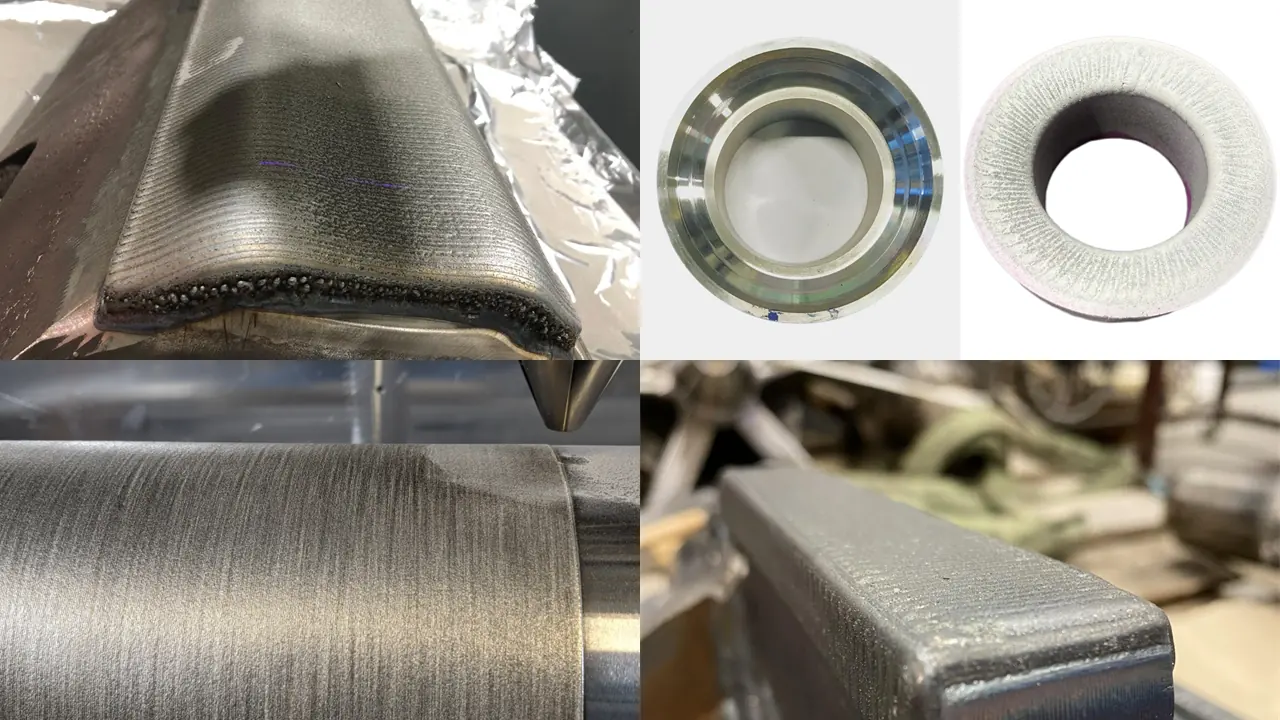
Exafuse developed an LMD coating route for turbo generator rotor wedges where the coating challenge was not only wear and corrosion resistance. The route also had to protect a copper substrate, manage temperature during deposition, produce a uniform coating layer and make repeat processing practical for multiple wedges.
The case centers on a CuNi2SiCr coating applied by Laser Metal Deposition with substrate preheating, temperature monitoring and batch-process thinking. This case study is the specific proof page. Use A31: LMD coatings on copper substrates as the generalized buyer guide.
Case snapshot
| Case element | Detail |
|---|---|
| Component | Turbo generator rotor wedges |
| Sector | Energy / power generation / turbomachinery |
| Base material context | Copper substrate / copper-rich component context |
| Coating route | LMD / laser cladding with CuNi2SiCr coating route |
| Main challenge | Improve surface performance while maintaining substrate integrity |
| Process focus | Preheating, absorption planning, temperature monitoring, interpass control and batch optimization |
| Buyer relevance | Heat-managed LMD coating route for critical copper-substrate components |
| Related guide | A31 generalized copper-substrate LMD coating article |
The problem
Rotor wedges are critical components in turbo generators. Their surface condition can affect reliability, service life and maintenance planning. The problem centers on wear and corrosion challenges on rotor wedges under demanding operating conditions.
The technical problem is broader than simply adding a harder layer:
- the coating must support wear and corrosion resistance;
- the copper substrate must remain structurally suitable;
- the laser process must manage absorption and heat flow;
- layer thickness and uniformity must be controlled;
- repeat processing should be efficient when multiple wedges are coated;
- inspection and release requirements need to match the component duty.
Coating objective
Batch optimization
The case also highlights parallel deposition across multiple rotor wedges as a way to reduce process time without compromising quality. This is an important commercial lesson for repeat components.
Batch strategy can help when:
- the components are similar enough for repeat fixturing;
- the thermal route can be managed across parts;
- inspection criteria are consistent;
- handling and documentation are planned from the beginning.
Result framing
Exafuse used LMD to develop a CuNi2SiCr coating route for turbo generator rotor wedges, combining material selection, substrate-aware heat management, temperature monitoring and batch-process thinking. The case supports Exafuse's ability to handle critical energy-sector coating problems where copper substrate behavior, layer uniformity and process documentation matter.
What buyers can learn
This case shows that copper-substrate coating projects should be treated as a complete process chain:
- start from the component duty and failure mode;
- review copper substrate behavior and thermal sensitivity;
- select the coating route around performance and compatibility;
- plan preheating or absorption strategy before deposition;
- monitor and control temperature during the build;
- design batch processing only when it supports quality;
- define inspection and release evidence before production.
What to send for a similar rotor wedge or copper-substrate coating review
Send:
- drawings, CAD or photos of the rotor wedge or copper component;
- base material and heat-treatment condition if known;
- current wear, corrosion or damage photos;
- coated zone dimensions and target layer thickness if known;
- required coating material if already specified;
- operating environment and failure mode;
- temperature limits or substrate restrictions;
- required final surface finish and tolerance;
- quantity and whether repeat batches are expected;
- inspection, test or documentation requirements;
- whether photos, video, organization names or process details can be used publicly.
Related article
Use A31: LMD coatings on copper substrates as the generalized education page. Use this CS14 case study as the detailed rotor wedge proof page.
Useful related content:
- Laser cladding for the service route.
- Materials for copper and alloy-family context.
- A13: Alloy selection for laser cladding.
- A11: Inspection stack.
- A20: Buyer qualification documents.
CTA
Send rotor wedge photos, substrate material, coating target, temperature constraints, quantity and inspection expectations for a coating feasibility review.