
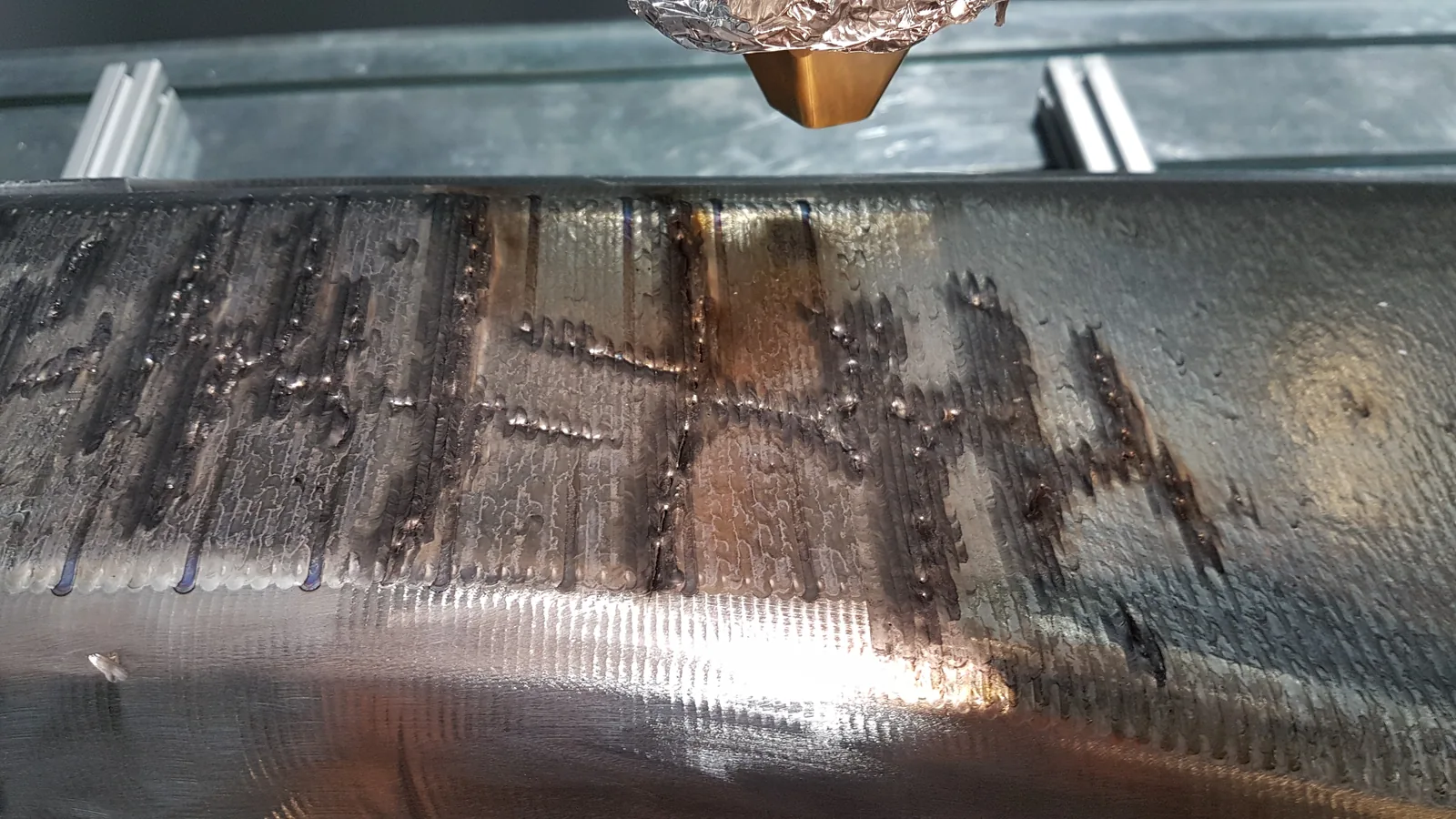
Forging hammer repair with Laser Metal Deposition (LMD) is worth evaluating when damage is local, the base hammer is still usable, oxides and cracks can be handled, and the rebuilt working face can be machined, inspected, and released against clear criteria. The strongest repair route is not just a hard coating. It is a system decision around base material, impact duty, surface preparation, deposited material, layer thickness, metallurgical bond, finishing, and evidence.
For the detailed Exafuse proof story, use the related case study: CS01 forging hammer repair with LMD. That case study is the place for the real hammer photos, 10-20 mm layer strategy, finished hammer visuals, thermal-spray comparison, evidence plot, and process video.
Who this article helps
This article is for teams that need to decide whether a worn forging hammer, hammer face, die area, or high-impact tool surface should be repaired, rebuilt, coated, or replaced.
It is most useful for:
- Maintenance and plant teams dealing with repeated impact wear.
- Forging shops comparing repair cost, downtime, and replacement lead time.
- Procurement teams preparing a repair RFQ for expensive tooling.
- Engineers comparing LMD, welding, thermal spraying, and replacement.
- Technical evaluators concerned about bond quality, cracking, hardness, toughness, and final geometry.
Direct answer
LMD can be a strong candidate for forging hammer repair when the problem is concentrated in defined working zones. The process can rebuild missing geometry and create a metallurgically bonded reinforced surface. The repaired area normally still needs surface preparation, machining, grinding, inspection, and release planning.
LMD should not be presented as a universal life-extension guarantee. Hammer duty is severe: repeated impact, abrasive wear, heat, scale, surface fatigue, and previous repair history all affect the result. A credible repair starts with the damaged zone and the acceptance criteria, not with the process name.
Why forging hammers are difficult repair parts
Forging hammers operate under repeated impact and high local stress. A repair can look visually acceptable and still fail if the material route is too brittle, the bond is weak, the heat-affected zone is unsuitable, or the final geometry does not match the working condition.
Common repair risks include:
- local face wear and dimensional loss;
- impact-related deformation;
- cracking at edges or transition zones;
- thermal cycling and scale-related wear;
- uncertain base material or heat-treatment history;
- repeated previous repairs;
- insufficient finishing allowance;
- weak inspection or release criteria.
That is why hardness alone is not enough. High-impact tooling needs a balance of wear resistance, toughness, substrate compatibility, dilution control, geometry recovery, and validation.
Why preparation decides the repair route
For forging hammers, preparation is part of the repair strategy. Oxide layers can weaken the metallurgical bond. Cracks, fatigue zones, or old repair boundaries can keep propagating if they are ignored before the new layer is deposited.
Before LMD, the review should address:
- oxide removal by grinding, blasting, or another suitable cleaning route;
- crack detection or scanning where cracking is visible or suspected;
- controlled crack repair or pre-filling when the base condition requires it;
- milling or machining to create a defined repair surface;
- enough stock allowance for final machining or grinding after deposition.
This is one reason a hammer can sometimes be sent in milled condition. A defined surface gives the LMD route a clearer start and makes the final repair easier to inspect.
When LMD is worth discussing
LMD is worth discussing when:
- the damaged zone is local and accessible;
- the base hammer is still structurally viable;
- replacement cost or lead time is painful;
- the working face needs both geometry recovery and surface reinforcement;
- a metallurgical bond is valuable for the duty;
- machining or grinding after deposition is possible;
- the customer can define what counts as an acceptable repaired hammer.
The strongest economic cases usually combine repair cost, downtime, spare-part availability, and repeatability. If the same hammer family returns repeatedly, the process and finishing route can often be improved over time.
LMD versus welding and thermal spraying
Welding, thermal spraying, and LMD can all be useful. The correct comparison depends on the failure mode and the release requirement.
LMD is often attractive when the project needs local material addition, a metallurgical bond, controlled build-up, and later machining. It can be used for thicker rebuild or reinforcement zones when the substrate, geometry, and heat input allow it.
Thermal spraying can be useful for certain surface coatings, but it is usually a different type of surface solution. For high-impact hammer faces, the buyer should ask whether the coating bond, thickness, toughness, and support from the substrate are enough for repeated impact duty.
Conventional welding may be suitable for some repairs, especially when the geometry and material allow it. It may be weaker when the buyer needs tighter local control, a tailored material route, or a clearer validation path for a specific working surface.
Replacement may still be the safer route when cracking is widespread, the base material cannot be identified, the whole tool body is degraded, or the required evidence cannot be produced economically.
Material strategy for impact wear
The material route for hammer repair should be selected around duty, not around a generic "harder is better" rule.
Important questions include:
- What is the base material?
- Is the dominant damage abrasive wear, impact, heat, cracking, or a combination?
- Does the layer need more toughness, more wear resistance, or a graded balance?
- How thick is the build-up or reinforcement zone?
- Will the repaired area be machined, ground, or heat treated?
- What inspection evidence is needed for release?
Exact powder blends, hardness values, and process parameters should remain project-specific unless separately approved for publication.
Repair chain for a forging hammer
A practical LMD repair review usually follows this route.
1. Intake and damage review
Review photos, dimensions, duty, cracks, wear depth, previous repairs, and replacement pressure. Confirm whether the damage is local enough for repair.
2. Surface preparation, oxide removal and machining strategy
Define whether the hammer should arrive as-worn, pre-machined, or milled to a defined condition. Remove oxide layers from the repair zone and decide how visible cracks, fatigue zones, or old repair boundaries will be handled. For repeat jobs, sending the hammer in a prepared milled condition can make the repair route clearer.
3. Material and layer strategy
Select the material family and layer logic around wear, toughness, bond, crack risk, and final geometry. The case-specific layer thickness and material sequence belong in the project evidence.
4. LMD deposition
Deposit material locally in the working zone. Toolpath, overlap, heat management, and stock allowance matter because the hammer still needs final shape recovery.
5. Finishing
Machine or grind the hammer to the required final geometry. Finished-surface photos are important because the buyer needs to understand the usable end condition, not only the deposition step.
6. Inspection and evidence
Agree the release evidence. This can include dimensional checks, surface inspection, hardness evidence, metallographic review, photos, or a project-specific performance comparison.
What to send for review
Send:
- photos of the worn hammer and working face;
- drawing or CAD if available;
- base material and heat-treatment history if known;
- overall dimensions and approximate weight;
- local wear depth and affected surface area;
- whether the hammer can be milled before sending;
- operating duty and failure history;
- whether cracking is present or suspected;
- whether oxide layers, scale, old weld repairs, or fatigue zones are present;
- required final geometry and surface finish;
- replacement cost, lead time, and downtime pressure;
- inspection or documentation requirements.
Recommended next steps
Start with:
- CS01 forging hammer repair case study for the detailed proof page.
- Repair and modification for the service route.
- Laser cladding when the main question is a reinforced working layer.
- Repair ROI calculator to compare downtime and replacement economics.
- Repair vs replace framework for commercial decision logic.
- Alloy selection for laser cladding for material-family tradeoffs.
- Metallurgical validation for bond and dilution questions.
- Inspection stack for release planning.
Request a hammer repair assessment
Send photos, base material, worn-zone dimensions, replacement lead time, and inspection expectations. Exafuse can review whether LMD repair, laser cladding, conventional repair, or replacement is the practical route.
FAQ
Can LMD repair forging hammers?
It can be evaluated when damage is local, the base hammer is still viable, the worn zone is accessible, and the repaired surface can be finished and inspected.
Is LMD better than thermal spraying for hammer repair?
Not automatically. The question is whether the surface needs a coating or a thicker metallurgically bonded rebuild/reinforcement. High-impact hammer faces often need bond, toughness, support, and geometry recovery to be reviewed together.
Can the hammer be sent in milled condition?
Yes, that can be a practical route. If the hammer is milled to a defined preparation condition before repair, the LMD build-up and final machining plan can be clearer.
Do oxides and cracks need to be handled before LMD?
Yes. Oxides can weaken bonding, and cracks or fatigue zones can continue to grow under impact. A repair review should include surface cleaning, crack review, and pre-filling or repair where needed before the reinforcement layer is deposited.
What layer thickness is possible?
Layer thickness is project-specific. The related CS01 case study is structured around a 10-20 mm LMD reinforcement layer strategy, but exact thickness depends on geometry, material, finishing allowance, and inspection.
Can LMD make the hammer last longer?
It can support life-extension work when the material route, bond, geometry, and validation match the duty. Public claims about service life should be tied to approved evidence for the specific hammer and operating condition.