
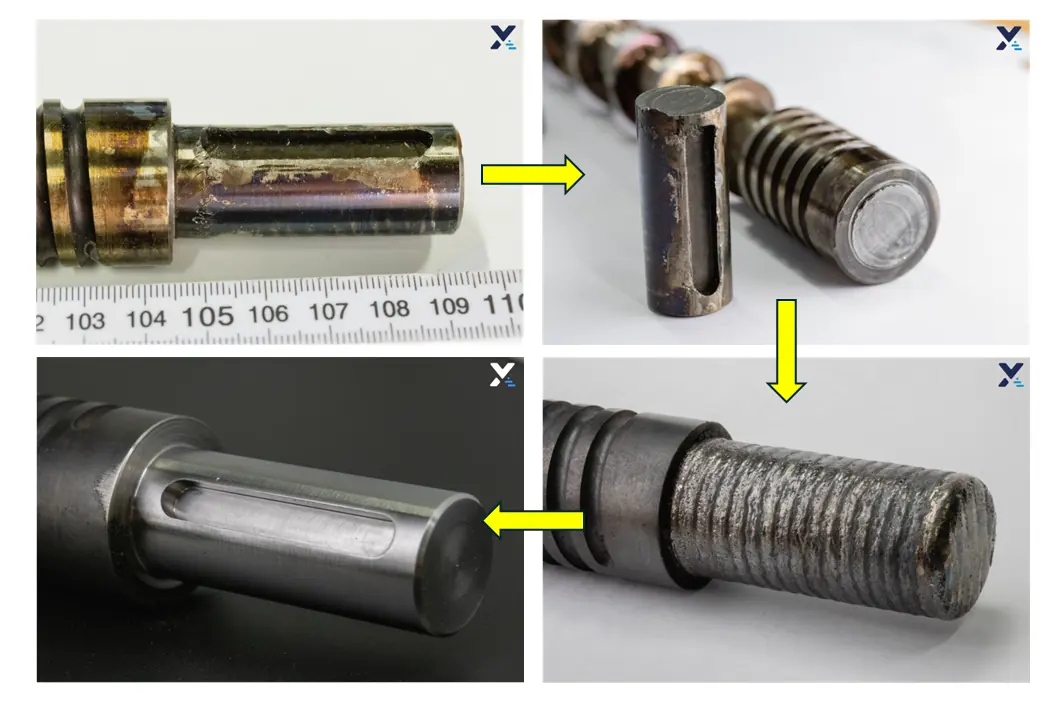
Repair toolpaths in LMD have to solve a real damaged geometry, not an ideal coupon. That means overlap, heat accumulation, access, machining allowance, and the transition back into the original part all matter at the same time. The best repair strategy is usually the one that restores function with the lowest thermal and geometric risk, not the one that simply fills the damaged volume fastest. For repair work discussed under LMD, DED, or Laserauftragschweißen, that path-planning discipline is what separates a credible industrial repair from a generic weld buildup.
Repairs are harder than flat demonstration parts
Real repairs start from wear, cracks, erosion, local deformation, or previous service damage. The repair zone may be irregular, constrained by surrounding features, and connected to base material with a different thermal history than a fresh coupon. That changes how the path should be built.
Start with damage mapping and the rebuild objective
Before path planning, the team has to decide what the rebuilt zone needs to become. Is the goal to restore stock for later machining, rebuild a worn edge, create a local wear layer, or transition into a repaired seating surface? The answer changes the overlap logic, the number of layers, and the finishing strategy.
Overlap strategy controls consistency
Bead overlap affects surface uniformity, bonding between tracks, and how much stock remains for finishing. Too little overlap can leave inconsistent fill or local defects. Too much overlap can add heat, change geometry, or shift the dilution behavior. That is why repair planning is not just about covering the area. It is about controlling how each pass relates to the next.
Heat management is part of the path, not a separate topic
Large local repairs can accumulate heat quickly, especially when the damaged zone is compact or surrounded by thick base material. The sequence of passes, the break points between zones, and the decision to distribute heat across the part all influence crack risk, distortion, and the condition of the transition zone.
Public proof context: forging hammer impact-wear repair
Exafuse has publicly described LMD-enhanced forging hammer repair work where targeted reinforcement of high-wear zones is the central logic. This is a useful path-planning example because hammer faces and forging-tool surfaces are not flat demonstration coupons: they combine impact duty, wear, geometry recovery, heat management and final finishing.
The safe takeaway is that LMD can be evaluated for local reinforcement when the damaged zone is accessible and inspectable. Every hammer geometry, material and previous repair history still needs technical review.
Access and orientation change what is practical
The same repair may need a different path strategy depending on whether the deposition head can approach the area cleanly, whether fixturing blocks access, and how the part is oriented. A technically sound repair route therefore combines geometry review with process planning instead of treating the path as an afterthought.
Plan the transition back into the original geometry
Repairs usually need to blend into existing surfaces and then be machined or finished back to function. That means the path has to leave the right stock and the right transition shape. A repair that deposits enough material but creates a poor transition can still fail the finishing stage.
Inspection points should be defined before the first bead
The repair plan should identify which zones are critical, where evidence will be gathered, and how the rebuilt geometry will be accepted after finishing. That can include dimensional checks, surface-focused inspection, or metallographic review when required by the scope.
What to send for a repair build-plan review
Send photos of the damaged area, the part drawing if available, the base material if known, and the dimensions of the affected zone. For forging hammers or similar tooling, include impact duty, wear depth, known cracks, previous repairs, replacement lead time and which surfaces must be restored precisely after the repair.