
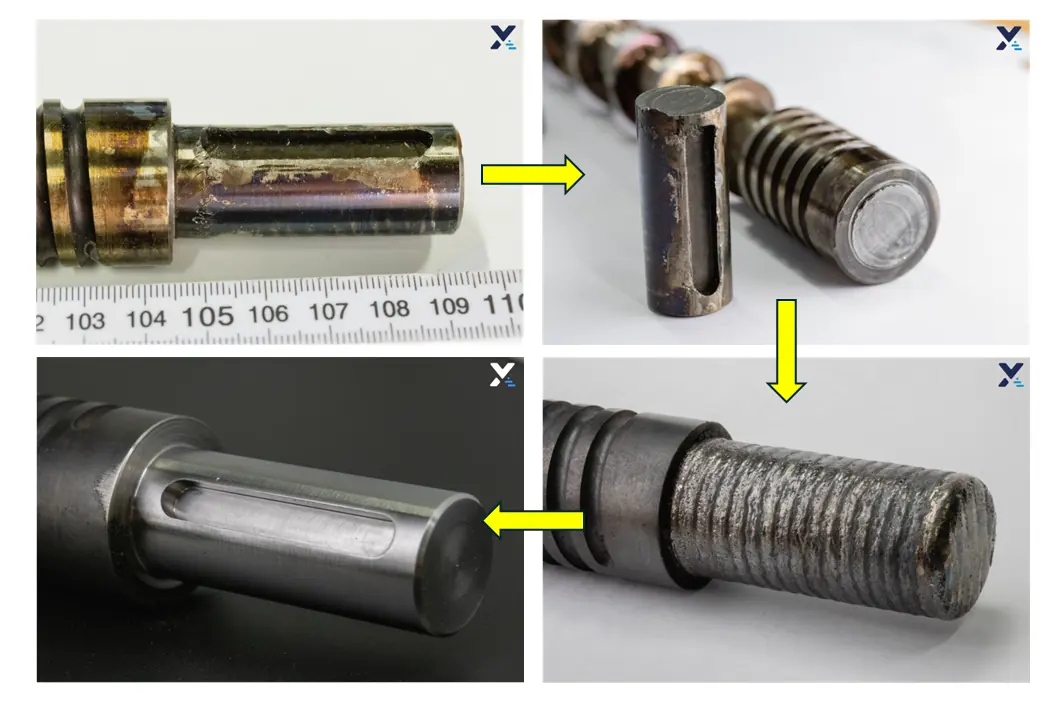
LMD can be worth evaluating for toothed industrial parts when the damage is local, the base component still has value, the material can be identified and the repaired geometry can be machined and inspected. This page is a generalized application guide for gears, pinions and similar parts.
Part types this guide covers
This guide is relevant for toothed and profiled metal parts where replacement cost, downtime or spare-part availability makes repair worth discussing.
Typical part names include:
- large gears;
- pinions;
- ring gears;
- gear rims;
- segment gears;
- sprockets;
- racks;
- splined shafts;
- coupling teeth;
- crusher or drive teeth;
- local tooth-profile features on larger assemblies.
The common thread is not the part name. The useful repair question is whether the damaged zone is local enough to rebuild, finish and inspect without turning the whole component into a higher-risk repair project.
Problems that can make LMD relevant
LMD repair can be evaluated when the damage is concentrated on a defined area:
- worn tooth flanks;
- chipped or undersized tooth sections;
- local impact damage;
- damaged edges or contact zones;
- machining errors on a toothed feature;
- wear on splines, coupling teeth or drive features;
- missing material where the nominal geometry is known.
The process is less attractive when the gear has systemic cracking, unknown base material, widespread fatigue, severe distortion, hidden internal damage or no realistic route for final profile machining and inspection.
Repair logic
The practical route is usually not "print a tooth and send it back." A credible repair route has several steps:
- Review the part, base material, duty and damaged geometry.
- Define the repair boundary and decide whether LMD is technically worth evaluating.
- Prepare the damaged surface so the deposition zone is clean and measurable.
- Add material locally with LMD / DED-LB/M.
- Machine or grind the rebuilt zone to the required tooth profile.
- Inspect the repaired area against agreed acceptance criteria.
For gears and similar parts, the final geometry usually comes from machining, not from the as-deposited LMD surface. That machining allowance should be planned before deposition starts.
Material direction and problem links
The material route should start from the failure mode and base material, not from a generic powder name.
For steel gears and toothed parts, Fe-based or tool-steel-type repair discussions may be relevant when the goal is compatible build-up and machinable restoration. If the duty includes sliding wear, adhesive wear, impact, corrosion or high temperature, the material discussion may move toward other alloy families or a cladding route.
Useful starting points:
- Materials overview for Fe-, Ni-, Co-, copper and carbide-reinforced family logic.
- Material selector for an early failure-mode to material-family direction.
- Alloy selection for laser cladding when the tooth or flank surface needs a protective layer.
- Failure modes to cladding solutions when the main question is wear mechanism, not geometry rebuild alone.
What must be verified
A gear repair discussion should define the evidence before the work starts.
Important checks can include:
- base material identification;
- crack condition and previous repair history;
- damaged-zone measurement;
- profile restoration route;
- final dimensional inspection;
- surface condition;
- hardness context where relevant;
- agreed NDT or metallographic checks where the duty requires it;
- documentation needed by maintenance, engineering or procurement.
Do not assume that a repaired tooth has the same load rating as a new gear unless the customer and supplier have agreed the required validation route.
When another route may be better
Replacement, conventional machining, welding or a new-build route may be better when:
- the part is low value and easily available;
- damage is distributed across many teeth;
- cracks or fatigue extend beyond the local repair zone;
- the base material is unknown and cannot be verified;
- the part cannot be machined after repair;
- the acceptance criteria require evidence that is not practical for the budget or deadline.
A serious repair review should be allowed to say "not a fit." That protects both the buyer and the supplier.
What to send for review
Send photos of the damaged tooth or profiled feature from several angles, drawing or CAD if available, base material, part diameter or main dimensions, approximate weight, current measured damage, required final profile, replacement cost, replacement lead time, operating duty and required inspection evidence.
CTA
Send gear, pinion or toothed-part photos with dimensions and base material for a repair feasibility review.