
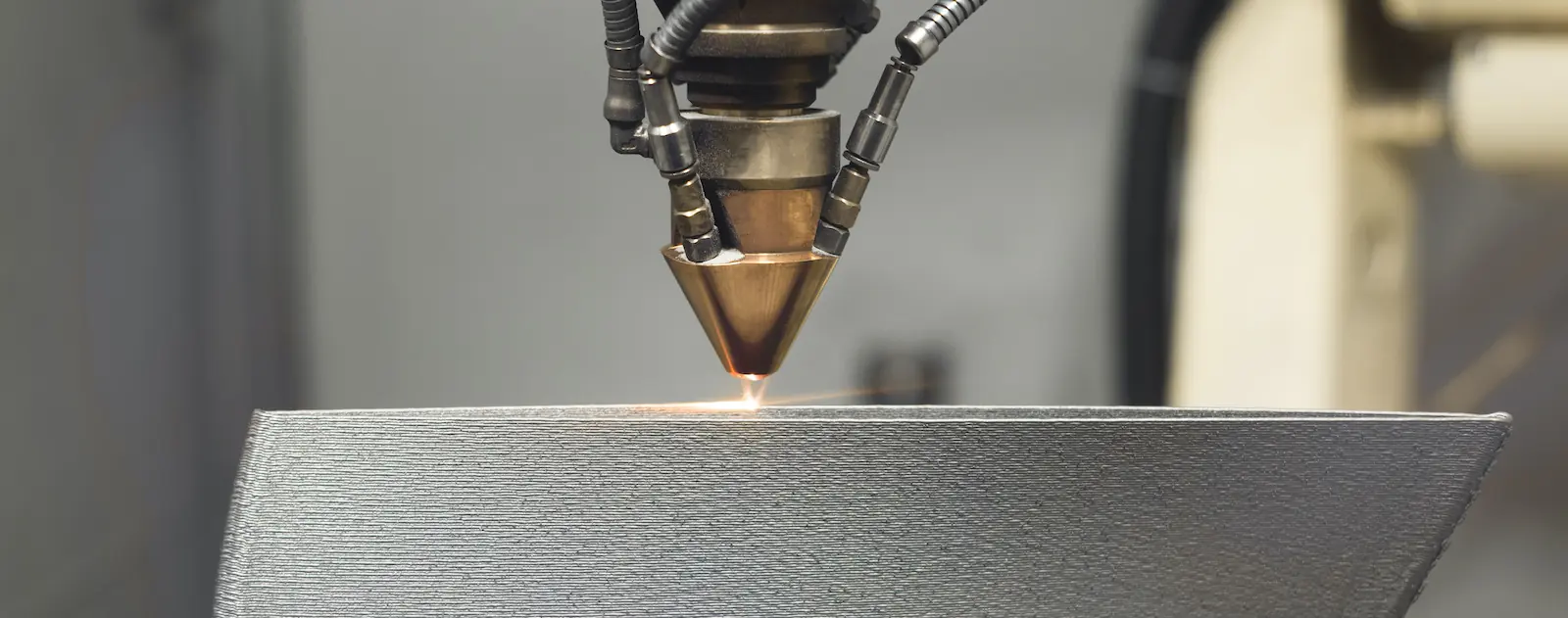
Laser Metal Deposition, or LMD, is a metal additive manufacturing process in which a laser creates a local melt pool and metal powder is fed into that melt pool. The process can build material locally, repair worn or damaged geometry, modify existing parts and create metallurgically bonded cladded surface layers.
In industrial buying decisions, LMD is often considered when a part is too valuable, too large or too specific to replace easily, or when material is only needed in defined zones. It is not the same as SLM / LPBF: LMD is typically used for local build-up, repair, large-part work and cladding, while SLM / LPBF is often considered for compact powder-bed parts with finer geometric detail.
Exafuse evaluates LMD, SLM / LPBF and hybrid additive manufacturing routes based on part geometry, base material, target surface, access, size, finishing requirements and inspection scope.
Who this article helps
This article is written for industrial buyers who need to decide whether Laser Metal Deposition, also known as LMD, DED, DED-LB/M or Laserauftragschweissen, is technically worth discussing for a part.
It is most useful for:
- Maintenance and plant engineers evaluating repair instead of replacement.
- Procurement teams preparing an RFQ for a metal AM, repair or cladding supplier.
- OEM and product development teams comparing LMD, SLM / LPBF and hybrid manufacturing.
- R&D and technical evaluators reviewing metallurgy, inspection and process limits.
- Buyers in DACH and Europe who need a practical route for high-value metal parts.
LMD, DED, Laserauftragschweissen and laser cladding: what is the difference?
Several terms are used in the market for closely related processes:
- LMD: Laser Metal Deposition.
- DED / DED-LB/M: Directed Energy Deposition using a laser beam for metal deposition.
- Laserauftragschweissen: German term commonly used for laser deposition welding.
- Laser cladding: usually used when the main goal is a protective surface layer.
- Laser deposition welding: often used for repair, build-up or modification work.
For buying decisions, the terminology matters less than the technical goal.
If the goal is a new metal part, the decision is usually between LMD, SLM / LPBF or a hybrid route. If the goal is a worn or damaged component, the question is whether LMD repair can restore geometry and function. If the goal is wear, corrosion, oxidation or sliding-contact protection, the discussion usually belongs in laser cladding.
When LMD is a good fit
LMD is often a fit when material must be added locally rather than removed from a larger block.
Typical fit cases include:
- A worn shaft, tool, mould, die, flange, edge or contact surface needs local build-up.
- A high-value part has undersized, damaged or modified geometry.
- A large component cannot easily fit into a powder-bed system.
- A surface zone needs a metallurgically bonded protective layer.
- A hybrid route is useful: add material with LMD, then machine or grind to final tolerance.
- A part has enough value, lead-time risk or technical importance to justify inspection and process planning.
LMD is also relevant when replacement is possible but unattractive because of long lead time, high part cost, missing spares, tooling changes or a difficult procurement route.
Rapid prototype proof: powder to functional drill in 24 hours
Exafuse has publicly shared a rapid LMD proof story in which a functional drill, described publicly as a "Bombenbohrer," was produced from metal powder with an antimagnetic coating in under 24 hours together with ZIPP Industries GmbH & Co. KG.
The useful lesson is not that every LMD part has a one-day lead time. It is that LMD can compress iteration when geometry, material direction, coating scope, finishing and the first acceptance target are clear enough at the beginning.
For buyers, this is a good example of how LMD can connect shape creation, material efficiency and custom surface function in one practical route.
Integrated workflow proof: 130 mm drill build and coating
Exafuse has also publicly shown a 130 mm "Bombenbohrer" drill video where LMD was used for both part fabrication from metal powder and final surface coating. The final layer was described as wear-resistant and anti-magnetic, from an alloy containing tungsten carbide.
This proof is useful because it shows LMD as a workflow, not only as a single deposition step. A buyer can discuss the built geometry, coating function, finishing route and validation plan in one process-selection review.
Multi-material proof: 750 mm water-cooled nozzle
Exafuse has also publicly shown a 750 mm water-cooled nozzle design manufactured by LMD with two Ni-based alloys: Inconel 625 for the inner structure and Inconel 718 for the outer structure and cooling ribs. The proof build was described with 1.8 mm thin-wall context, around 50 hours of uninterrupted printing and more than 1,070 layers.
This is a useful example for industrial buyers because it connects geometry, material zoning, cooling-feature logic, path planning and process stability. It should still be treated as a proof of capability and engineering direction, not as a guarantee that every thin-wall or multi-material design is automatically feasible.
When LMD is not the right fit
LMD is not the best answer for every metal part.
It may not be the right fit when:
- The part is low value and standard replacement is faster or cheaper.
- The geometry requires very fine powder-bed detail across the full part.
- The required surface finish cannot be reached without acceptable post-processing.
- The base material is unknown and cannot be verified.
- The damaged area is not accessible for the laser, powder stream, fixturing or later machining.
- The acceptance criteria require certification or test evidence that has not been planned.
- The part condition is too degraded to define a reliable repair boundary.
A useful LMD review should start with the part condition, function, base material, access and acceptance criteria, not with the additive process alone.
How Laser Metal Deposition works
LMD is a controlled build-up process. It creates a local molten zone on a metal substrate and adds powder into that zone.
1. Part review and route selection
The part geometry, material, damage condition, functional surfaces and target result are reviewed first. For new parts, this may include CAD data and design intent. For repairs, it includes damage photos, worn dimensions and the required restored geometry.
The first question is whether the route should be:
- LMD / DED build-up.
- SLM / LPBF manufacture.
- Hybrid LMD plus machining.
- Laser cladding.
- Conventional machining, welding or replacement instead.
2. Surface preparation and setup
The relevant surface must be prepared so deposition can be planned. Depending on the part and task, this may include cleaning, pre-machining, fixturing and definition of the build-up area.
For repairs, the damaged zone usually has to be made measurable before the final toolpath can be defined.
3. Melt pool creation
A laser creates a local melt pool on the metal surface. The melt pool is the zone where the existing material and the added material interact.
This is what distinguishes LMD from a purely mechanical coating method. The deposited material is metallurgically bonded to the substrate.
4. Powder feeding and track formation
Metal powder is fed into the laser-created melt pool. As the toolpath moves, a deposited track is formed.
Multiple tracks and layers can be used to build up geometry, restore missing volume or create a cladded surface layer.
5. Post-processing and inspection
LMD is usually not the final step. Depending on the function of the part, the deposited area may need machining, grinding, heat treatment or other finishing steps.
Inspection may include dimensional checks, microscopy, metallographic preparation and agreed documentation.
LMD vs SLM / LPBF vs hybrid manufacturing
LMD and SLM / LPBF are both metal additive manufacturing routes, but they solve different problems.
| Decision point | LMD / DED-LB/M | SLM / LPBF | Hybrid route |
|---|---|---|---|
| Basic principle | Laser creates a melt pool and powder is fed into it | Part is built in a powder-bed process | Add material with LMD, then machine, grind or finish |
| Typical use | Local build-up, repair, modification, cladding and larger parts | Compact new parts with powder-bed geometry requirements | Functional surfaces, near-net features, repair plus final tolerance |
| Existing part required? | Often yes, especially for repair and modification | Usually no; part is built from a build platform | Often yes for repair, no for new hybrid parts |
| Surface condition | Often requires post-processing for functional surfaces | Often finer as-built detail than LMD, but still may require finishing | Final surface can be defined by machining or grinding |
| Exafuse capability context | 3-axis Titan LMD with 4 m3 build space and parts up to 2 m x 1 m x 2 m; 6-axis robotic LMD with 6 x 5 x 4 m installation space and rotary-table support up to 1,000 kg | TRUMPF TruPrint 3000 with 400 mm diameter build platform, 400 mm build height and 500 W single-laser capability | Depends on geometry, access, machining allowance and acceptance criteria |
| Buyer question | Can local deposition solve the problem? | Does the whole part suit powder-bed manufacture? | Can additive build-up and subtractive finishing reduce risk? |
A practical rule is simple: use LMD when the value is in adding material only where needed. Use SLM / LPBF when the value is in building a compact part in a powder-bed route. Use a hybrid route when the part needs additive geometry but also final machined accuracy.
For a structured comparison, use the LMD vs SLM decider or review the process overview on technology.html#process-selection.
Materials and alloy selection
LMD material selection should be treated as an engineering decision, not as a generic powder choice.
Exafuse frames LMD and laser cladding material discussions around:
- Fe-based alloy families.
- Ni-based alloy families.
- Co-based alloy families.
- Copper alloy and specialty steel discussions where the part logic supports them.
- Carbide-reinforced options where technically appropriate.
The right material route depends on the base material, target function, service environment, wear mechanism, corrosion or oxidation exposure, machining needs and inspection requirements. Public Exafuse material examples include 316L stainless steel, Inconel 625, C276, C282, Triballoy 400, Triballoy 800, Cu 99.95%, CuNi3Si and selected specialty steels, but named grades still need part-specific review.
For cladding, the main question is usually not "Which powder is strongest?" but:
- What failure mode must the surface resist?
- What base material is being deposited onto?
- How much dilution is acceptable?
- What thickness and surface finish are required?
- Will the layer be machined or ground after deposition?
- What documentation is needed for acceptance?
For a material-specific route, start with the materials overview or use the material selector.
Process limits and machine constraints
LMD is flexible, but it is not unlimited.
Important constraints include:
- Access: the laser, powder stream and toolpath must reach the deposition zone.
- Part size and handling: the public Exafuse LMD picture includes a 3-axis Titan system with 4 m3 build space for parts up to 2 m x 1 m x 2 m, and a 6-axis robotic LMD system with 6 x 5 x 4 m installation space and rotary-table support up to 1,000 kg.
- Wall and feature context: the 3-axis Titan route is described publicly with LMD wall widths from 1.8 mm to 3.7 mm. The 6-axis robotic route uses zoom optics for wall adjustment from 1.5 mm to 4.5 mm. Final detail, tolerance and surface quality still depend on the part, setup and finishing route.
- Heat input: thermal effects must be considered, especially for repair parts and distortion-sensitive geometries.
- Finishing allowance: functional surfaces may need machining, grinding, heat treatment or other post-processing.
- Inspection scope: quality checks must match the risk level of the part.
Machine capability alone does not decide feasibility. The final route depends on the part, the material, the required finish and the agreed inspection plan.
Quality, inspection and validation
A useful LMD project defines quality before deposition starts.
For industrial parts, the buyer and supplier should agree on:
- Base material information.
- Target deposit material or alloy family.
- Functional surfaces.
- Required dimensions and tolerances.
- Machining or grinding allowance.
- Visual acceptance criteria.
- Required documentation.
- Inspection method and sampling level.
- Whether microscopy or metallographic preparation is needed.
Quality planning may include dimensional checks, microscopy, metallographic preparation and agreed documentation. Process monitoring workflows and process data handling can support process understanding, but article text alone should not be treated as a guarantee of performance, certified properties or final acceptance.
For inspection and validation planning, review quality.html.
Cost, lead time and procurement implications
LMD cost is not defined only by deposition time.
The main cost and lead-time drivers are usually:
- Part size and handling.
- Deposition volume or surface area.
- Base material and powder family.
- Preparation and fixturing.
- Toolpath planning.
- Machining, grinding or heat treatment.
- Inspection and documentation.
- Quantity and repeatability.
- Urgency and logistics.
For procurement, the key question is whether LMD reduces total risk compared with replacement, conventional welding, machining from billet or a new SLM / LPBF build.
For repair cases, this includes downtime, replacement lead time, spare-part availability and confidence in the repaired function. For new builds, it includes manufacturability, finishing, inspection and whether the geometry is better suited to LMD, SLM / LPBF or a hybrid route.
Use the estimator for an early cost direction, the repair ROI tool for repair-vs-replacement cases, or the RFQ builder to prepare a clearer request.
What to send Exafuse for a feasibility review
A useful LMD review starts with practical part data.
For a new part or hybrid manufacturing request, send:
- CAD model and technical drawing.
- Material or required alloy family.
- Part size, weight and quantity.
- Functional surfaces and tolerance requirements.
- Target surface finish.
- Areas that may be machined, ground or heat treated.
- Operating conditions if they affect material selection.
- Required inspection or documentation.
- Target lead time.
- For urgent prototypes, what the first part must prove and which requirements can wait for a later iteration.
- For multi-material or cooling-feature requests, clearly marked material zones and the functional reason for each zone.
For a repair or modification request, send:
- Damage photos from several angles.
- Original drawing or nominal geometry if available.
- Actual measured dimensions of the worn or damaged area.
- Base material information.
- Part size and approximate weight.
- Description of how the part failed or wore.
- Functional surfaces that must be restored.
- Required post-processing and inspection.
- Replacement cost or lead time if relevant.
For a cladding request, send:
- Base material.
- Failure mode: wear, corrosion, oxidation, hot wear or sliding contact.
- Surface area to be protected.
- Target layer thickness if known.
- Required final finish.
- Operating environment.
- Inspection expectations.
Recommended next steps
Start with the service page that matches your intent:
- For new parts, LMD / SLM selection or hybrid manufacturing: Metal AM.
- For worn, damaged, undersized or modified parts: Repair and modification.
- For wear, corrosion, oxidation or tribology surfaces: Laser cladding.
Useful technical pages:
- LMD vs SLM process selection.
- Equipment and capability overview.
- Materials and alloy selection.
- Quality, inspection and documentation.
- Research and monitoring direction.
- Case studies.
Related articles to connect in this cluster:
- A04: LMD vs SLM process-selection matrix.
- A06: LMD for large metal parts.
- A18: Hybrid manufacturing with LMD and CNC.
- A22: LMD for hard-to-machine alloys.
- A26: From metal powder to functional drill in 24 hours.
- A27: 750 mm water-cooled nozzle by multi-material LMD.
- A30: general LMD build-and-coat workflow guide.
- CS13: 130 mm Bombenbohrer build-and-coat LMD proof case.
If you are preparing a request, build a structured package with the RFQ builder.
Send a process-selection request
Send CAD, material, size, target finish and functional requirements for a process-selection review.
Contact Exafuse for a manufacturing review
If the part is worn or damaged, use the repair route instead: contact.html?intent=repair. If the goal is a protective surface layer, use the cladding route: contact.html?intent=cladding.
FAQ
What is Laser Metal Deposition?
Laser Metal Deposition is a metal additive manufacturing process in which a laser creates a melt pool and metal powder is fed into that melt pool. The deposited material bonds metallurgically with the substrate and can be used for build-up, repair, modification or cladding.
Is LMD the same as DED?
LMD is a laser-based form of Directed Energy Deposition for metals. Buyers may see terms such as LMD, DED, DED-LB/M, laser deposition welding or Laserauftragschweissen used for related process descriptions.
Is LMD the same as SLM / LPBF?
No. LMD feeds powder into a laser-created melt pool on a part or substrate. SLM / LPBF builds parts in a powder-bed process. LMD is often considered for local build-up, large-part work, repair and cladding. SLM / LPBF is often considered for compact parts that suit a powder-bed route.
Can LMD make complete metal parts?
Yes, LMD can be used to build metal geometry, but the best route depends on size, accuracy, material, surface finish and post-processing. Some parts are better suited to SLM / LPBF or to a hybrid additive-plus-machining route.
Can LMD build a part and add a functional coating?
It can be evaluated. Exafuse has publicly shown a 130 mm drill proof where LMD was used for both geometry fabrication and final surface coating. The route still depends on material compatibility, coating function, finishing access and inspection.
Can LMD repair worn or damaged parts?
LMD can be evaluated for restoring worn, damaged, undersized or modified metal parts. Feasibility depends on the base material, damage condition, access, required geometry, finishing allowance and inspection requirements.
Does an LMD part need machining?
Often, yes. LMD can build material efficiently, but functional surfaces may still require machining, grinding, heat treatment or other post-processing to meet final requirements.
Which materials can be used for LMD or laser cladding?
Exafuse frames material discussions around Fe-based, Ni-based and Co-based alloy families, with carbide-reinforced options where appropriate. Final material selection depends on the base material, function, failure mode and validation plan.
What should I send for an LMD feasibility check?
Send CAD or drawings, material information, size, weight, photos if the part is damaged, target geometry, functional surfaces, tolerance requirements, operating conditions and required inspection documentation.