
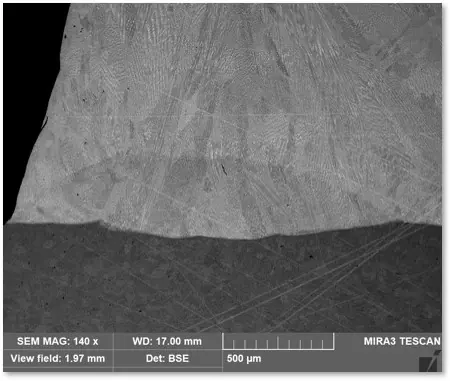
Porosity risk in LMD should be treated as an evidence question, not as something checked only by looking at the final surface. Exafuse can use non-confidential trials, coupons and non-confidential demonstrators to investigate porosity drivers, review process stability and define a better inspection route for buyer projects.
Why porosity matters
Porosity can affect confidence in a repaired, built or coated part. The relevance depends on where the pores are, what the part does, what the acceptance criteria are and whether the defect type matters for the service condition.
For buyers, the practical question is not "Can porosity ever happen?" The useful question is:
- Which defect types matter for this part?
- Where could they appear?
- How will they be detected?
- What acceptance level is required?
- Which process variables and preparation steps reduce the risk?
- What evidence is needed before release?
Internal research route
A publication-ready Exafuse research page can describe the method without exposing confidential recipes.
The workflow can be framed as:
- Define the quality question for a part family, material route or test coupon.
- Prepare the substrate, powder route and deposition plan.
- Produce internal samples or non-confidential demonstrators.
- Section selected areas for metallographic preparation.
- Review the cross-sections with microscopy.
- Compare pore type, location and possible process drivers.
- Adjust the preparation, path, powder feed, shielding or heat route where appropriate.
- Repeat the evidence loop until the process window is better understood.
This is research and process-learning language. It should not be written as a guarantee that every LMD part will be pore-free.
Possible porosity drivers to discuss
The public page can discuss drivers at a general level:
- powder condition and handling;
- surface preparation;
- shielding and gas environment;
- melt-pool stability;
- path overlap and layer strategy;
- dilution and wetting behavior;
- heat accumulation;
- material compatibility;
- geometry transitions or stop/start areas.
The exact cause for a given part should be determined by evidence, not guessed from the surface appearance alone.
What buyers can learn
This research note should help buyers understand that quality planning starts before deposition.
Useful buyer lessons:
- define the critical zones before processing;
- decide which defects matter for the part function;
- choose inspection methods that answer the release question;
- use metallography and microscopy where surface inspection is not enough;
- treat process monitoring as support evidence, not as a replacement for acceptance inspection;
- avoid demanding unnecessary tests that do not improve the release decision.
Links to quality and material pages
Porosity is connected to material choice, process route and inspection scope.
Useful starting points:
- Quality and inspection for release planning.
- Materials overview for material-family and substrate context.
- Metallurgical validation for bond, dilution, microstructure and crack-risk questions.
- Inspection stack for LMD, repair and cladding for practical evidence selection.
- Monitoring and control in LMD for process data context.
What to send for a quality discussion
Send part geometry, material, critical zones, required acceptance criteria, known defect concerns, previous failure information, inspection requirements and whether metallographic evidence or external testing is expected.
CTA
Send the quality question, material route and acceptance criteria for an LMD inspection-plan discussion.