
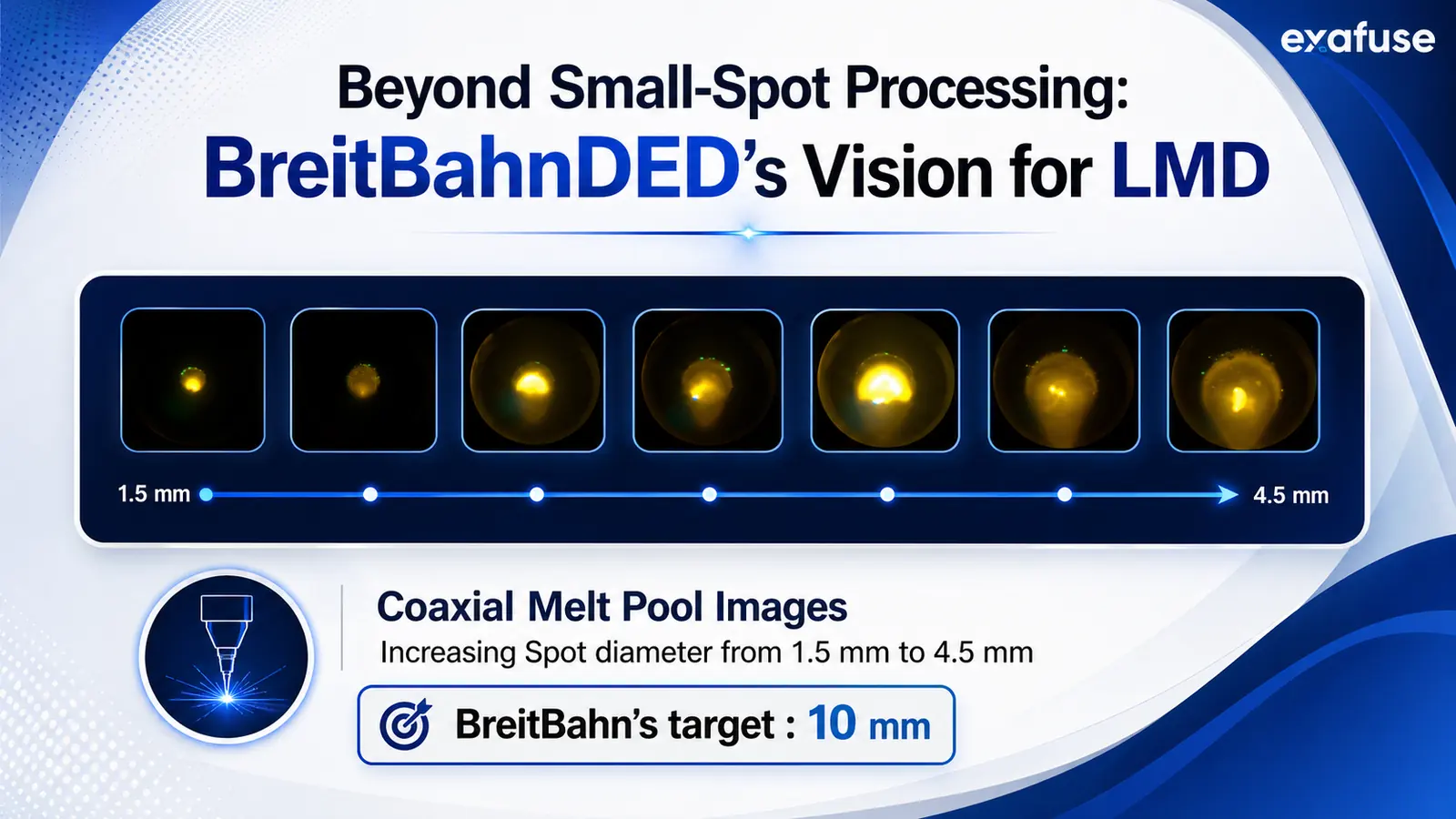


BreitBahnDED is a publicly funded research project for developing wider weld beads in Laser Metal Deposition, also known as DED-LB/M or Laserauftragschweissen. The industrial question is simple: can large-area deposition become faster without losing control of melt-pool stability, geometry, temperature distribution and final validation?
The project is officially focused on system and process development for generating broad weld tracks in laser cladding and Directed Energy Deposition with multispot optics. For Exafuse, the relevance is direct: large components, repair build-up and protective coatings often depend on how efficiently material can be added over a large surface or volume.
The productivity limit in conventional LMD tracks
Laser Metal Deposition is useful for manufacturing, repairing and coating metal components, but large surfaces can become slow when each individual track is narrow. Conventional LMD tracks are often in the 1-4 mm range. Large builds or broad coatings therefore require many overlapping paths.
That creates three practical problems. First, the toolpath count increases processing time. Second, overlap zones can become quality-sensitive areas if heat, bead shape or powder delivery are not controlled. Third, simply enlarging the laser focus and power can create new risks such as uneven heat distribution, unstable melt pools, distortion and higher operating cost.
The BreitBahnDED approach
BreitBahnDED investigates rotating multispot optics instead of relying on one enlarged laser spot. The laser beam is divided into several spots, and those spots are rotated quickly through an opto-mechanical system.
The project goal is to create wider and more uniform deposition tracks. Public project communication describes an initial target around 5 mm and a potential path toward 10 mm tracks. These are research targets, not a promise that every customer part can be deposited at that width.
What is being developed
The project is not only an optics topic. It combines hardware, powder delivery, sensing and control:
- A new LMD processing head that integrates rotating multispot optics.
- A dynamic powder-feeding system with dead-time-compensated control for more precise material delivery.
- Multimodal sensing with CMOS cameras, pyrometers and triangulation sensors for process observation.
- Real-time control algorithms for melt-pool stabilization.
- Adaptive layer-to-layer control to support more consistent build quality.
Expected industrial benefits
If the technology works as intended, wider and more stable tracks could reduce processing time for large components and coatings. Public project wording refers to potential time savings of 30-50% and a powder-utilization target above 95%. These should be read as project goals or estimates, not as guaranteed customer outcomes.
The broader industrial benefit is easier to state: fewer tracks, more controlled heat distribution and better process observation could make large-area LMD, repair and coating more productive where the part geometry is suitable.
The project consortium
BreitBahnDED brings together research and industrial partners:
- Ruhr University Bochum, Chair for Laser Application Technology (LAT), project coordination.
- LMB Automation GmbH.
- Kamp und Koetter GmbH.
- Ruhr University Bochum, Chair of Control Engineering and Systems Theory.
- ThinkIng - Additive Technology GmbH, operating publicly as Exafuse.
The project is co-funded by the European Union through the European Regional Development Fund and the Just Transition Fund under the ERDF/JTF Programme NRW 2021-2027, within the "Industrie.IN.NRW - Innovative Materials and Intelligent Production" competition call.
Exafuse's role
Exafuse contributes the application perspective: large-volume LMD parts, demanding wear-protection coatings, repair use cases and alloy-processing experience. That matters because wide-bead research only becomes industrially useful when it survives real part constraints.
In the project, Exafuse supports system-design and simulation input based on industrial applications, contributes to hardware and software integration, and helps validate and iteratively optimize the prototype process. The focus is application-oriented testing, especially for larger parts and challenging materials.
Where wider-bead LMD could fit
Wider-bead strategies are most relevant when deposition volume, coating area or repair build-up dominates the economics. They are less relevant when the part depends on small details, sharp local features or very limited finishing allowance.
For buyers, the takeaway is that LMD productivity is not only about machine power. It is also about bead strategy, powder delivery, heat management, monitoring, finishing and inspection.
What to send if you want to discuss a pilot or R&D case
Send the part geometry, approximate deposition volume, base material, critical surfaces, finishing requirements and service conditions. For repair or coating, add photos of the affected area and describe the failure mode. That gives Exafuse a practical basis for deciding whether a higher-throughput deposition strategy is relevant.