
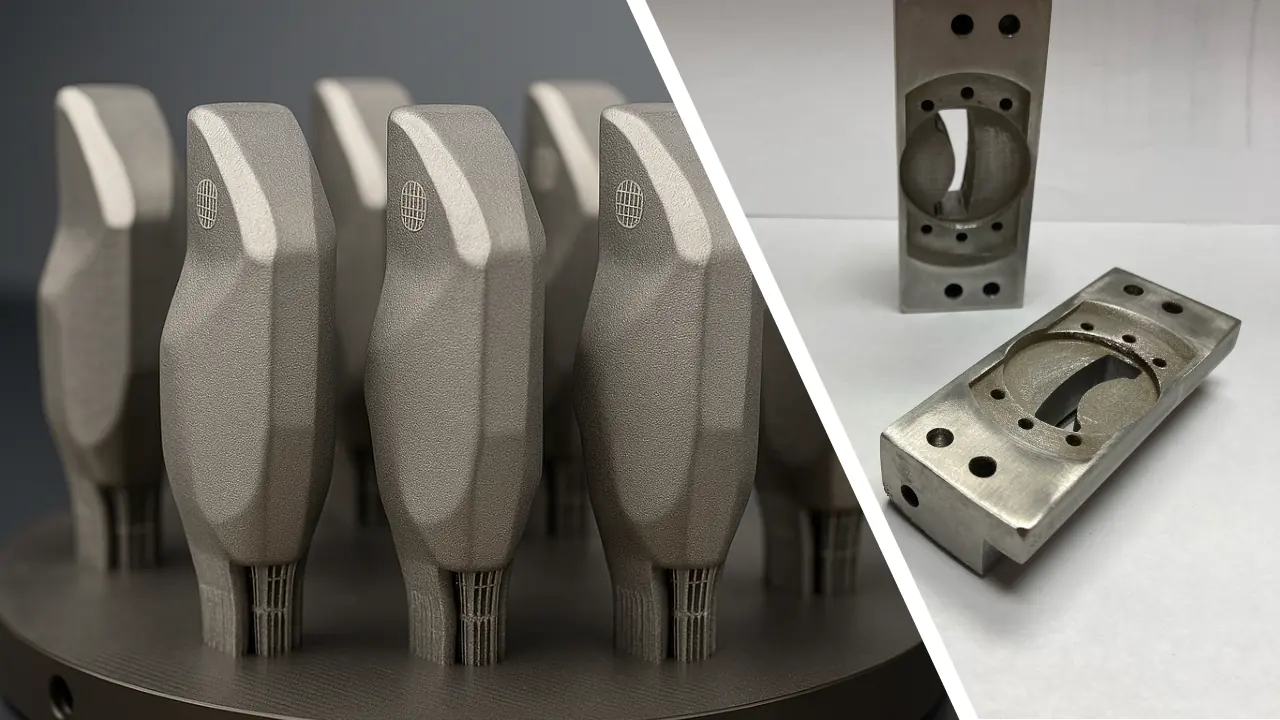
LMD and SLM solve different industrial problems. LMD or DED is usually stronger for large parts, repair, local buildup, and laser cladding, while SLM or PBF is usually stronger for compact parts that depend on fine geometry, enclosed channels, and powder-bed-level detail. In German industrial discussions, the LMD side of that comparison is often described as Laserauftragschweißen or DED-LB/M when the job is really a build-up, repair, or cladding problem rather than a powder-bed part.
The short comparison
| Decision question | LMD / DED | SLM / PBF |
|---|---|---|
| Large part size | Strong fit | Limited by chamber |
| Repair of existing part | Strong fit | Not a repair-first route |
| Local feature addition | Strong fit | Usually not the right tool |
| Fine internal features | Limited | Strong fit |
| Near-net build plus machining | Common | Also possible, but different economics |
| Laser cladding / coatings | Core use case | Not the same process class |
How the processes differ
LMD feeds material into a laser-created melt pool and deposits it where needed, often onto an existing part or a larger free-form build surface. SLM selectively fuses powder inside a powder-bed chamber layer by layer. The biggest buying difference is therefore not the acronym but the build logic: deposition route versus powder-bed route.
Where LMD usually wins
LMD is usually the better candidate when the part is large, when material only needs to be added locally, or when the job is really a repair, modification, or coating problem rather than a clean-sheet powder-bed part. It also fits near-net-shape strategies where the part will be finished afterward by machining or grinding. For industrial service work, that combination is often more relevant than maximum as-built detail.
Where SLM usually wins
SLM is typically stronger when the value of the part comes from fine feature size, internal channels, lattice structures, or compact high-detail geometry throughout the whole part. If the design requires a powder-bed-style level of resolution and the part fits the chamber logic, SLM often becomes the better starting point. That does not make it universally better; it just means it serves a different geometry class well.
Why the comparison is often really LMD plus finishing versus SLM plus finishing
Neither route should be framed as "press print and ship." In LMD work, functional interfaces, fits, and critical surfaces often come from a hybrid route: deposition first, then machining or grinding. SLM parts may also need finishing, but the nature of the post-process and the reason for choosing the route are different.
How buyers should choose
Start with six questions: how large is the part, how fine are the required features, is this a repair or a new build, what finishing route is acceptable, what is the quantity, and what qualification risk matters most. If the part is large, worn, or only needs material added in selected zones, LMD should be evaluated early. If the value lies in compact internal complexity, SLM is usually the stronger candidate.
What to send for process-selection support
Send the CAD model or drawing, overall size, material, critical features, and whether the job is a new build, repair, or coating problem. Also state what surfaces matter most, what post-processing is acceptable, and whether chamber size or lead time is already a constraint. That allows the process discussion to be engineering-led rather than based on buzzwords.